When businesses in Egypt need to move large volumes of goods internationally, FCL sea shipment Egypt services become the backbone of their supply chain operations. Full Container Load (FCL) shipping offers exclusive use of an entire container, providing security, efficiency, and cost-effectiveness for substantial cargo volumes. Whether you’re exporting Egyptian textiles to Europe or importing machinery from Asia, understanding how FCL sea freight works in Egypt can transform your logistics strategy.
What Is FCL Sea Shipment?
FCL sea freight stands for Full Container Load shipping, where your business rents an entire shipping container exclusively for your cargo. Unlike Less than Container Load (LCL) shipments that share container space with other shippers, FCL gives you complete control over the container from origin to destination.
In Egypt’s bustling ports—including Alexandria, Port Said, and Damietta—FCL shipments represent a significant portion of international trade. The country’s strategic location between Europe, Asia, and Africa makes it an ideal hub for FCL sea shipment operations.
Key characteristics of FCL shipping:
- Exclusive container use for a single shipper
- Direct loading and unloading without consolidation delays
- Enhanced security as goods aren’t handled multiple times
- Cost-effective for shipments exceeding 15 cubic meters
- Faster transit times compared to LCL alternatives
Top Benefits of Choosing FCL Sea Freight Egypt
Selecting FCL sea shipment Egypt services delivers multiple advantages that directly impact your bottom line and operational efficiency.
Enhanced Security and Reduced Damage Risk
When you book an FCL container, your goods are loaded once at origin and remain sealed until they reach their final destination. This minimizes handling, significantly reducing the risk of damage, loss, or theft. For Egyptian exporters shipping delicate products like ceramics or electronics, this security is invaluable.
Predictable Transit Times
FCL shipments follow direct routes without the consolidation and deconsolidation delays typical of LCL freight. Egyptian businesses shipping time-sensitive goods—whether fresh produce to European markets or automotive parts to the Middle East—benefit from more reliable delivery schedules.
Cost Efficiency for Large Volumes
While the upfront cost appears higher than LCL, FCL becomes more economical when shipping volumes exceed 15 cubic meters. Egyptian manufacturers moving full production runs find that FCL rates per cubic meter often beat LCL pricing, especially on popular routes from Egypt to the USA, Europe, or the Gulf states.
Simplified Customs Procedures
Egyptian customs clearance processes become more straightforward with FCL shipments. Since the entire container belongs to one shipper, documentation is less complex, and customs officials can inspect and clear shipments more efficiently at Egyptian ports.
Common Challenges with FCL Sea shipment and How GCT Freight Solves Them
Despite its advantages, FCL sea shipment Egypt operations face several challenges that can disrupt supply chains.
Port Congestion at Egyptian Facilities
Egyptian ports occasionally experience congestion, particularly during peak seasons. This can delay container pickup and delivery, impacting your supply chain timeline. GCT Freight addresses this through strategic partnerships with port authorities and real-time monitoring systems that identify alternative routing options when necessary.
Fluctuating Freight Rates
Ocean freight rates can vary dramatically based on fuel costs, seasonal demand, and global shipping capacity. GCT Freight’s strong relationships with NVOCC in Egypt and major shipping lines help secure competitive rates even during market volatility.
Documentation Complexity
Egyptian export regulations require meticulous documentation. Missing or incorrect paperwork can result in costly delays. GCT Freight’s experienced team manages all documentation requirements, from commercial invoices to certificates of origin, ensuring compliance with both Egyptian and destination country regulations.
Container Availability Issues
During high-demand periods, finding available containers in Egyptian ports can be challenging. GCT Freight maintains strategic relationships with container leasing companies and shipping lines, guaranteeing container availability for your shipments even during peak seasons.
FCL Sea Shipment Rates: How Much Does It Cost to Ship a Full Container?
Understanding FCL sea shipment Egypt pricing helps you budget effectively and make informed logistics decisions. FCL rates vary based on several critical factors:
| Factor | Impact on Pricing |
| Container Size | 20ft containers cost less than 40ft or 40ft High Cube options |
| Route & Destination | Popular routes (Egypt to USA, Europe) have more competitive rates |
| Seasonal Demand | Peak seasons (September-November) see 20-40% rate increases |
| Fuel Surcharges | BAF (Bunker Adjustment Factor) fluctuates with oil prices |
| Port Congestion | Delays may incur detention and demurrage fees |
| Cargo Type | Hazardous or temperature-controlled goods cost premium rates |
Sample FCL Rate Ranges from Egyptian Ports (2025)
- Egypt to USA (East Coast): $2,800 – $4,200 for 40ft container
- Egypt to Europe (Mediterranean): $1,500 – $2,800 for 40ft container
- Egypt to China: $2,200 – $3,500 for 40ft container
- Egypt to UAE: $900 – $1,600 for 40ft container
These rates represent base ocean freight only. Additional costs include local charges discussed in the next section.
FCL Sea Shipment Price Trends and Market Insights 2025
The global shipping landscape continues evolving, with several factors influencing FCL sea shipment Egypt rates throughout 2025.
According to the World Shipping Council, container shipping rates have stabilized after the volatility of 2021-2023, but regional variations persist. For Egyptian shippers, several trends are shaping the market:
Red Sea Security Concerns: Ongoing security issues near the Bab el-Mandeb strait have led some carriers to reroute around Africa, increasing transit times and costs for certain routes by 15-25%.
Green Shipping Initiatives: International Maritime Organization (IMO) regulations pushing for reduced emissions are driving carriers to invest in cleaner vessels. These investments are gradually being reflected in freight rates through environmental surcharges.
Digital Transformation: Egypt freight forwarders are increasingly adopting digital booking platforms and real-time tracking systems, improving transparency and efficiency in FCL operations.
Suez Canal Developments: Egypt’s ongoing investments in Suez Canal infrastructure continue enhancing capacity, positioning Egyptian ports as strategic transshipment hubs for FCL cargo moving between Asia and Europe.
Additional FCL Sea Shipment Costs and Local Fees in Egypt
Beyond base ocean freight rates, Egyptian FCL shippers must budget for various local charges and fees:
Origin Charges (Egypt):
- Terminal Handling Charges (THC): $200-350 per container
- Bill of Lading fees: $30-50
- VGM (Verified Gross Mass) certification: $25-40
- Customs documentation: $50-150
- Container seal: $5-10
- Port security fees: $15-30
Destination Charges:
- Destination THC: Varies by country ($250-500 typical)
- Customs clearance fees: $100-300
- Delivery to final destination: Based on distance
- Import duties and taxes: Calculated on cargo value
Potential Additional Fees:
- Demurrage (container detention at port): $75-150 per day after free time
- Detention (container held beyond free time): $50-100 per day
- Chassis rental: $25-40 per day (USA destinations)
- Fumigation (if required): $150-300
Understanding these costs helps Egyptian businesses accurately calculate total sea freight expenses and avoid budget surprises.
Expert Tips to Get the Best FCL Sea Shipment Pricing
Securing competitive FCL sea shipment Egypt rates requires strategic planning and industry knowledge. Here are proven tactics from logistics professionals:
Book During Off-Peak Periods
Freight rates fluctuate seasonally. If your shipping schedule allows flexibility, book containers during shoulder seasons (March-May, September-October) when demand softens and carriers offer more competitive rates.
Consolidate Shipments When Possible
Rather than shipping multiple LCL shipments monthly, consolidate orders into regular FCL containers. This approach reduces per-unit shipping costs and simplifies logistics management.
Negotiate Annual Contracts
For businesses with consistent shipping volumes, negotiating annual contracts with freight forwarders or NVOCC in Egypt can secure fixed rates, protecting against market volatility and ensuring priority service during peak periods.
Optimize Container Utilization
Maximize your investment by fully utilizing container capacity. A 40ft High Cube container offers 76 cubic meters—ensure your packing strategy uses every inch efficiently. Consider adjusting order quantities or bundling complementary products to fill containers completely.
Leverage Multiple Port Options
Egypt’s several major ports—Alexandria, Port Said, Damietta, Ain Sokhna—each offer different advantages. Sometimes using an alternative port can yield better rates or faster transit times depending on your destination.
Partner with Established Egypt Freight Forwarders
Experienced freight forwarders in Egypt have negotiated volume discounts with carriers and can pass savings to clients. They also navigate local regulations efficiently, avoiding costly mistakes.
Ready to Ship Your Full Container?
Chat with Our Team on WhatsApp
Don’t let logistics complexity hold back your business growth. Contact GCT Freight today for a customized FCL sea freight quote and discover how we can optimize your international shipping strategy.
FCL Sea Freight Process: From Booking to Delivery (Step-by-Step)
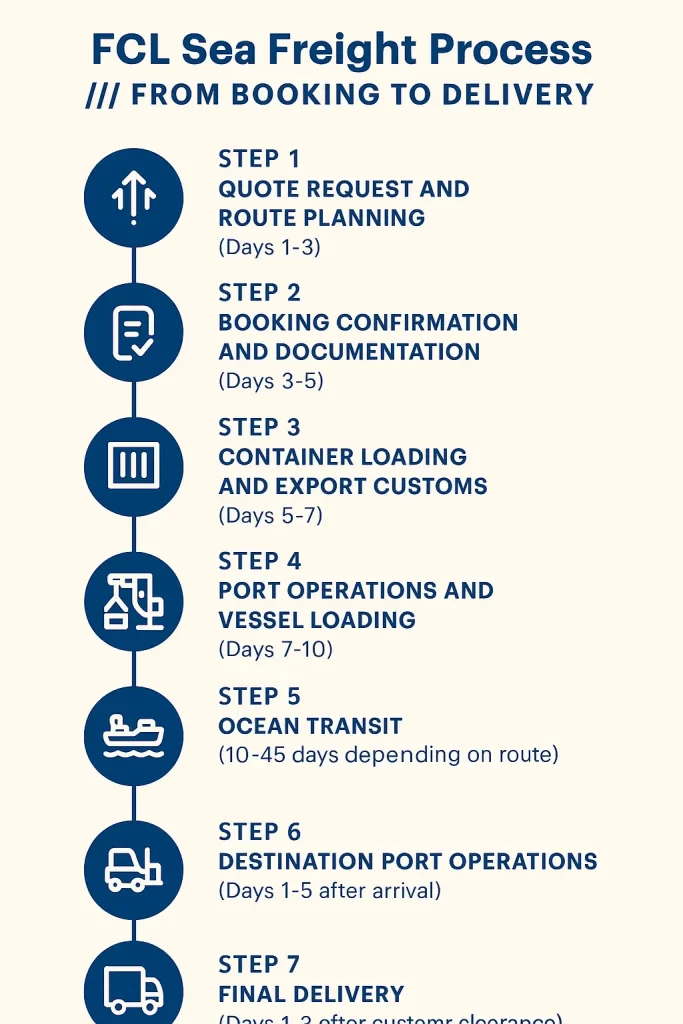
Understanding the complete FCL journey helps Egyptian businesses manage expectations and prepare for each stage:
Step 1: Quote Request and Route Planning (Days 1-3)
Contact your freight forwarder with shipment details: cargo description, volume, weight, origin, destination, and preferred timeline. GCT Freight analyzes optimal routes, considering factors like transit time, cost, and reliability.
Step 2: Booking Confirmation and Documentation (Days 3-5)
Once you accept the quote, your forwarder reserves container space with the shipping line. Simultaneously, prepare required documents: commercial invoice, packing list, certificate of origin, and any product-specific certifications.
Step 3: Container Loading and Export Customs (Days 5-7)
The empty container arrives at your facility or nominated warehouse. After loading, your freight forwarder arranges customs clearance at the Egyptian port, submitting all documentation to customs authorities for inspection and approval.
Step 4: Port Operations and Vessel Loading (Days 7-10)
The container moves to the port terminal, undergoes security screening, and is loaded onto the vessel. Your forwarder provides the Bill of Lading, the crucial legal document representing ownership and required for cargo release at destination.
Step 5: Ocean Transit (10-45 days depending on route)
Your container travels via ocean vessel along the designated route. Modern tracking systems allow real-time monitoring of vessel position and estimated arrival times.
Step 6: Destination Port Operations (Days 1-5 after arrival)
Upon arrival, the container is unloaded and moves to the terminal yard. Import customs clearance occurs, potentially involving physical inspection. Duties and taxes are calculated and paid.
Step 7: Final Delivery (Days 1-3 after customs clearance)
The cleared container is either picked up by your nominated trucking company or delivered by your freight forwarder to the final destination, completing the FCL journey.
FCL Container Sizes and Capacity Guide
Selecting the appropriate container size is crucial for cost-effective FCL sea shipment Egypt operations. Here’s a comprehensive breakdown:
20-Foot Standard Container (20ft GP)
Dimensions:
- Internal Length: 5.89m (19.3ft)
- Internal Width: 2.35m (7.7ft)
- Internal Height: 2.39m (7.8ft)
- Capacity: 33 cubic meters
- Maximum Payload: 28,000 kg
Best For: Dense, heavy cargo like machinery, metal products, or small to medium shipment volumes.
40-Foot Standard Container (40ft GP)
Dimensions:
- Internal Length: 12.03m (39.5ft)
- Internal Width: 2.35m (7.7ft)
- Internal Height: 2.39m (7.8ft)
- Capacity: 67 cubic meters
- Maximum Payload: 26,000 kg
Best For: Standard cargo volumes that don’t require extra height, offering better value per cubic meter than 20ft containers.
40-Foot High Cube Container (40ft HC)
Dimensions:
- Internal Length: 12.03m (39.5ft)
- Internal Width: 2.35m (7.7ft)
- Internal Height: 2.69m (8.9ft)
- Capacity: 76 cubic meters
- Maximum Payload: 26,000 kg
Best For: Lightweight, voluminous cargo like textiles, furniture, or products requiring maximum cubic capacity. This is the most popular FCL container choice globally.
Specialized Containers
Refrigerated Containers (Reefers): Temperature-controlled for perishable goods, pharmaceuticals, or chemicals requiring specific temperature ranges (-30°C to +30°C).
Open Top Containers: For oversized cargo that needs top loading, such as machinery or construction equipment.
Flat Rack Containers: For heavy, oversized cargo like industrial equipment, vehicles, or construction materials that don’t fit standard containers.
How to Track Your FCL Sea Shipment Easily?
Modern FCL sea shipment Egypt tracking capabilities provide unprecedented visibility into your cargo’s journey, reducing uncertainty and enabling proactive supply chain management.
Container Tracking Methods
Bill of Lading Number Tracking: Every FCL shipment receives a unique B/L number. Most shipping lines offer online tracking portals where you enter this number to view real-time container status, current location, and estimated arrival times.
Container Number Tracking: Each container has a unique identification number (typically 11 characters). This can be tracked through the shipping line’s website or third-party tracking platforms like Container Tracking.
Booking Number Tracking: Your freight forwarder provides a booking reference number that tracks the shipment through their internal system, offering additional details beyond basic container location.
GCT Freight’s Advanced Tracking Solutions
At GCT Freight, we understand that visibility equals control. Our clients benefit from:
- Real-time GPS tracking for containers throughout the journey
- Automated notifications via email or SMS for milestone events (departure, arrival, customs clearance)
- Dedicated customer portal providing 24/7 access to shipment status and documentation
- Proactive exception management alerting you to potential delays before they impact your business
For comprehensive FCL sea shipment Egypt tracking, partnering with experienced Egypt freight forwarders ensures you’re never in the dark about your cargo’s whereabouts.
How to Book Your FCL Sea Freight in Four Simple Steps
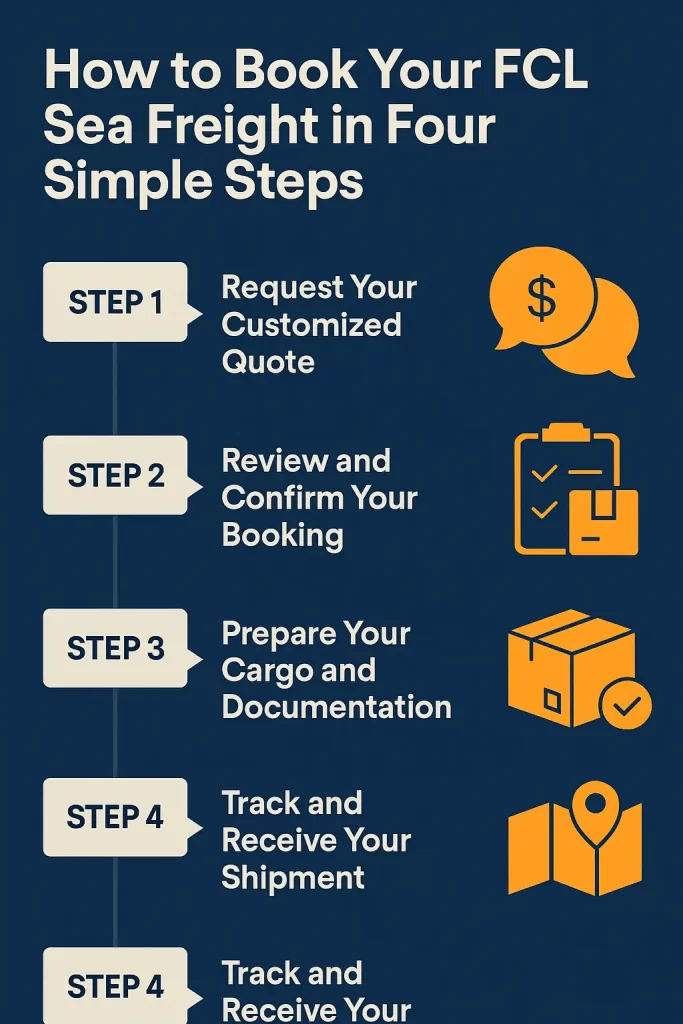
Getting started with FCL sea shipment Egypt services through GCT Freight is straightforward:
Step 1: Request Your Customized Quote
Visit our services page or book a pick up directly. Provide details about your cargo: type, volume, weight, pickup location in Egypt, destination country, and preferred shipping timeline.
Step 2: Review and Confirm Your Booking
Our team analyzes your requirements and presents a comprehensive quote including ocean freight rates, local charges, transit time estimates, and recommended container size. Review terms and confirm your booking to secure container space.
Step 3: Prepare Your Cargo and Documentation
Follow our preparation guidelines to pack your cargo efficiently. Our team guides you through required documentation based on your destination country’s import regulations, ensuring compliance with both Egyptian export and foreign import requirements.
Step 4: Track and Receive Your Shipment
Once your container ships, use our tracking systems to monitor progress. We handle all logistics at destination, coordinating with local partners for customs clearance and final delivery to your specified address.
For additional resources on logistics of shipping in Egypt, explore our comprehensive resources page.
Why Choose GCT Freight for FCL Sea Shipment in Egypt
As one of Egypt’s leading freight forwarding companies, GCT Freight brings unmatched expertise to FCL sea shipment Egypt operations:
30+ Years of Egyptian Logistics Experience: We understand the unique challenges of shipping from Egyptian ports and have refined our processes to deliver consistent results.
Comprehensive Service Portfolio: Beyond sea freight, we offer air freight, road express, and customs clearance, providing complete supply chain solutions.
NVOCC Partnerships: As an established NVOCC in Egypt, we secure preferential rates with major shipping lines, passing cost savings directly to our clients.
Technology-Driven Operations: Our digital platforms provide real-time tracking, automated documentation, and seamless communication, bringing modern efficiency to traditional freight forwarding.
Dedicated Customer Support: Our multilingual team provides personalized attention, responding to inquiries within hours and proactively managing your shipments throughout the journey.
Global Network: With partnerships across 150+ countries, we ensure your FCL shipments receive expert handling at every origin and destination worldwide.
Discover more about our approach to modern shipping services and how we’re transforming freight forwarding in Egypt.
Ready to Ship Your Full Container?
Chat with Our Team on WhatsApp
Don’t let logistics complexity hold back your business growth. Contact GCT Freight today for a customized FCL sea freight quote and discover how we can optimize your international shipping strategy.
FAQ
Q: What’s the difference between FCL and LCL sea freight?
A: FCL (Full Container Load) means you rent an entire container exclusively for your cargo, while LCL (Less than Container Load) means your goods share container space with other shippers. FCL becomes more cost-effective when your shipment exceeds 15 cubic meters and offers faster transit times with reduced handling.
Q: How long does FCL sea shipment from Egypt typically take?
A: Transit times vary by destination. Egypt to Europe typically takes 10-15 days, Egypt to USA East Coast requires 20-25 days, Egypt to USA West Coast needs 30-35 days, and Egypt to Asia ranges from 15-25 days. These times don’t include customs clearance and inland transportation.
Q: Can I ship different products in the same FCL container?
A: Absolutely. As long as the products are compatible and don’t require different handling conditions (like mixing frozen goods with dry cargo), you can mix multiple product types in one FCL container. This flexibility helps maximize container utilization.
Q: What documents do I need for FCL sea shipment from Egypt?
A: Essential documents include commercial invoice, packing list, Bill of Lading, certificate of origin, and any product-specific certifications (health certificates for food, MSDS for chemicals, etc.). Your freight forwarder will guide you through destination-specific requirements.
Q: How are FCL sea freight rates calculated?
A: Rates depend on container size, origin-destination route, seasonal demand, fuel costs, cargo type, and current market conditions. Unlike LCL charged by volume, FCL is a flat rate per container, making it more economical for larger shipments.
Q: What happens if my cargo doesn’t fill the entire container?
A: You still pay for the full container, but proper packing techniques can accommodate smaller volumes efficiently. Consider consolidating multiple orders or coordinating with your freight forwarder to optimize timing. For volumes under 15 cubic meters, LCL might be more economical.
Q: Are there weight limits for FCL containers?
A: Yes. While 40ft containers offer 76 cubic meters of space, the maximum payload is typically 26,000-28,000 kg depending on container type. Dense cargo like metals or machinery may reach weight limits before filling the container’s volume capacity.
Q: How do I track my FCL shipment from Egypt?
A: You can track using your Bill of Lading number, container number, or booking reference through the shipping line’s website, your freight forwarder’s portal, or third-party tracking platforms. GCT Freight provides real-time GPS tracking and automated milestone notifications.
Q: What are demurrage and detention charges?
A: Demurrage charges apply when containers remain at the port terminal beyond free time (typically 5-7 days). Detention charges apply when you hold the container at your facility beyond the allowed period. Both can cost $50-150 per day, making timely pickup crucial.
Q: Which Egyptian port is best for FCL shipments?
A: It depends on your location and destination. Alexandria handles the highest volume and offers extensive route options. Port Said excels for transshipment and Asian routes. Damietta serves northeastern Egypt efficiently. Ain Sokhna provides excellent access for Red Sea and Asian destinations. Your freight forwarder can recommend the optimal port for your specific needs.
Looking for more information on Egyptian freight services? Check out our guides on sea export freight forwarding process and growth of Egyptian sea shipping.