When time-sensitive shipments can’t wait for scheduled flights, businesses turn to air cargo charters. Understanding cargo plane charter cost is essential for companies managing logistics budgets while ensuring their freight reaches destinations quickly and safely. This comprehensive guide breaks down everything you need to know about charter pricing, from aircraft types to cost-saving strategies.
“Last Updated of This Article: November 2025”
WHAT IS AIR CARGO CHARTER?
Air cargo charter refers to the rental of an entire aircraft dedicated exclusively to transporting your freight. Unlike commercial air freight services that consolidate multiple shippers’ cargo on scheduled flights, a charter flight operates on your timeline and route specifications.
Chartered cargo flights provide ultimate flexibility for businesses shipping:
- Oversized or heavy equipment
- Temperature-sensitive pharmaceuticals
- Just-in-time manufacturing components
- Emergency relief supplies
- High-value goods requiring enhanced security
According to the International Air Transport Association (IATA), the global air cargo charter market has grown significantly, with companies increasingly recognizing the value of dedicated freight solutions during supply chain disruptions.
AIR CARGO CHARTER: SWIFT & DEDICATED FREIGHT SOLUTIONS
The primary advantage of chartering a cargo plane is speed combined with flexibility. When production lines face shutdown due to missing parts, or when natural disasters require immediate humanitarian aid, charter services deliver solutions that scheduled cargo services cannot match.
Key benefits include:
- Direct routing – Fly point-to-point without hub transfers
- Schedule control – Depart when you need, not when airlines schedule
- Dedicated capacity – The entire aircraft carries only your freight
- Reduced handling – Fewer touchpoints minimize damage risk
- Access to remote locations – Reach airports unavailable to commercial carriers
Major industries relying on cargo charters include aerospace, automotive, pharmaceuticals, energy, and humanitarian organizations. The flexibility of charter operations makes them invaluable for managing unexpected logistics challenges. Learn more about modern shipping services that complement charter operations.
TOP ROUTES FOR CARGO CHARTER
Understanding popular charter routes helps contextualize pricing variations. Cargo plane charter cost fluctuates based on geographic demand and infrastructure availability.
| Route Type | Examples | Cost Factors |
| Transoceanic | US-Europe, Asia-Europe | Longer distance, higher fuel costs |
| Regional | Within EU, Within Asia | Shorter distances, competitive pricing |
| Remote Access | Oil fields, mining sites | Limited infrastructure, specialized aircraft |
| Humanitarian | Disaster zones, conflict areas | Risk premiums, insurance costs |
High-demand corridors between manufacturing hubs in Asia and consumer markets in North America or Europe typically offer more competitive rates due to available aircraft positioning. Conversely, routes to remote locations with limited airport infrastructure command premium pricing. For regional logistics, consider the logistics of shipping in Egypt and how geographic factors impact pricing.
SPOTLIGHT ON AIRCRAFT
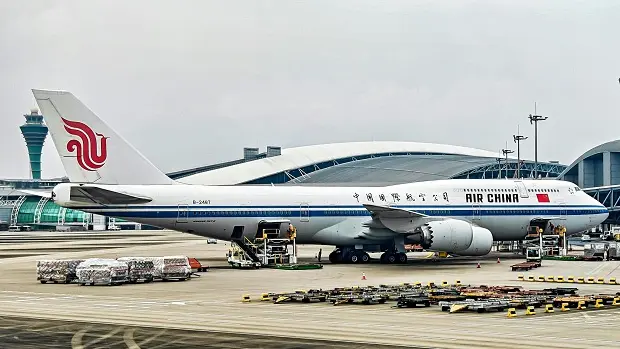
The type of aircraft significantly impacts charter costs. Understanding aircraft categories helps you select the most cost-effective option for your cargo requirements.
Common Cargo Charter Aircraft:
Small Cargo Aircraft (up to 10,000 lbs)
- Examples: Cessna Caravan, Pilatus PC-12
- Best for: Express documents, small urgent parts
- Typical range: 1,000-1,500 miles
Medium Cargo Aircraft (10,000-40,000 lbs)
- Best for: Regional freight, e-commerce fulfillment
- Typical range: 800-1,200 miles
Large Cargo Aircraft (40,000-100,000 lbs)
- Examples: Boeing 737-400F, Airbus A300F
- Best for: Heavy machinery, large shipments
- Typical range: 2,000-3,000 miles
Heavy Cargo Aircraft (100,000+ lbs)
- Examples: Boeing 747-400F, Boeing 777F, Antonov An-124
- Best for: Outsized cargo, multiple pallets
- Typical range: 4,000-8,000+ miles
Selecting the right aircraft size optimizes your cargo plane charter cost by avoiding paying for unused capacity while ensuring your freight fits safely. Explore air cargo management solutions to help determine the best aircraft for your needs.
Boeing 777F Charter Cost Per Hour
Boeing 777F Charter: Premium Long-Haul Cargo Solution
The Boeing 777 Freighter stands as one of the most capable and efficient wide-body cargo aircraft available for charter operations. Understanding Boeing 777F charter cost per hour helps businesses evaluate whether this premium aircraft suits their logistics requirements.
Boeing 777F Specifications & Capabilities
Cargo Capacity:
- Maximum payload: 224,900 lbs (102,000 kg)
- Cargo volume: 27,520 cubic feet
- Main deck pallets: 27 positions (96″ x 125″)
- Lower deck pallets: 10 positions plus bulk cargo
Performance Characteristics:
- Maximum range: 4,900 nautical miles (9,070 km)
- Cruising speed: Mach 0.84 (544 mph / 876 km/h)
- Service ceiling: 43,100 feet
- Fuel capacity: 47,890 gallons
Ideal Applications:
- Transoceanic heavy freight shipments
- High-value electronics and automotive parts
- Large pharmaceutical shipments requiring temperature control
- Multiple pallet consolidations for e-commerce operations
- Emergency equipment for oil & gas projects
Boeing 777F Charter Cost Breakdown
Hourly Operating Rates: The Boeing 777F charter cost per hour typically ranges from $35,000 to $55,000 depending on several factors:
- Base rate: $35,000-$42,000/hour (standard operations)
- Peak season premium: Additional 15-25% during high-demand periods
- Remote destination surcharge: $5,000-$10,000/hour extra for challenging airports
- Specialized equipment: $2,000-$5,000/hour for temperature-controlled operations
Sample Route Pricing (Boeing 777F):
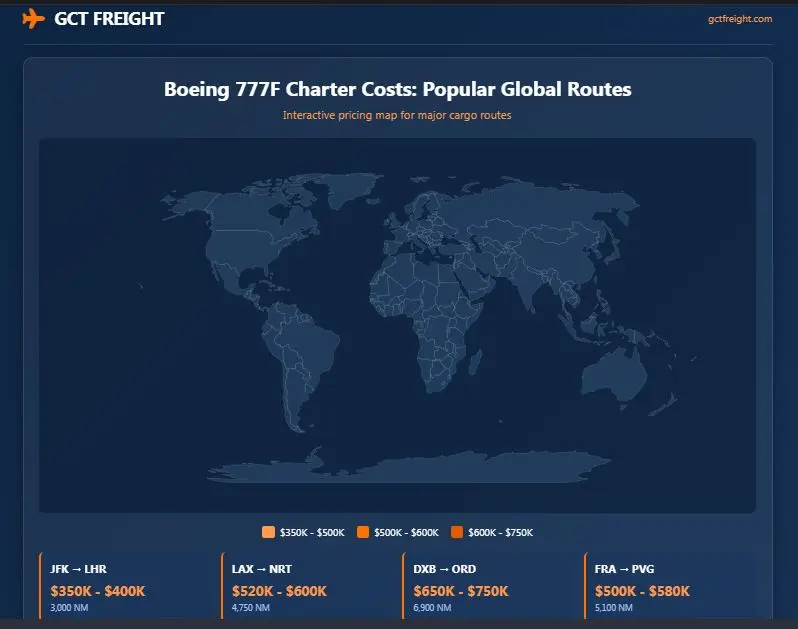
| Route | Flight Time | Base Cost | Total Estimated Cost* |
| New York (JFK) → London (LHR) | 7.5 hours | $296,250 | $350,000-$400,000 |
| Los Angeles (LAX) → Tokyo (NRT) | 11 hours | $440,000 | $520,000-$600,000 |
| Dubai (DXB) → Chicago (ORD) | 14 hours | $560,000 | $650,000-$750,000 |
| Frankfurt (FRA) → Shanghai (PVG) | 10.5 hours | $420,000 | $500,000-$580,000 |
*Total includes positioning, landing fees, handling charges, crew expenses, and fuel surcharges
Additional Boeing 777F Charter Expenses
Positioning Fees: If the aircraft must reposition from its current location to your departure airport, expect positioning charges of $25,000-$45,000 per flight hour. Strategic departure timing can minimize these costs when aircraft are already nearby.
Airport and Handling Charges:
- Major hub airports (JFK, LHR, NRT): $8,000-$15,000
- Secondary airports: $4,000-$8,000
- Remote locations: $10,000-$25,000+
Crew and Operational Costs:
- Flight crew (2 pilots, 1 flight engineer): Included in hourly rate
- Crew overnight accommodations (if required): $500-$1,200
- Crew per diem: $150-$300 per crew member per day
Cargo Handling Equipment:
- Standard forklifts and loaders: Usually included
- Specialized lifting equipment: $2,000-$8,000
- Temperature monitoring systems: $1,500-$3,500
- Hazmat handling certification: $3,000-$7,000
Boeing 777F vs Other Wide-Body Freighters
Cost Comparison Per Flight Hour:
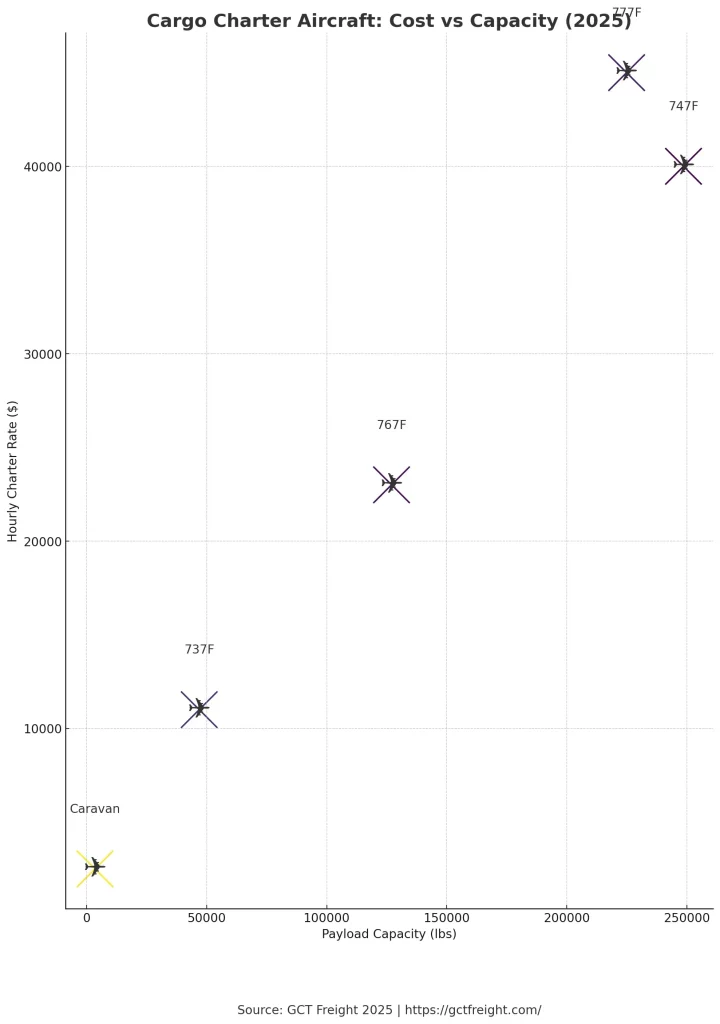
| Aircraft | Hourly Rate | Payload Capacity | Best For |
| Boeing 777F | $35,000-$55,000 | 224,900 lbs | Long-haul heavy cargo |
| Boeing 747-400F | $30,000-$50,000 | 248,600 lbs | Maximum capacity needs |
| Boeing 767-300F | $18,000-$30,000 | 127,000 lbs | Mid-range operations |
| Airbus A330-200F | $22,000-$38,000 | 154,000 lbs | Flexible mid-to-long haul |
Why Choose Boeing 777F:
- Fuel efficiency: 18% better fuel economy than 747-400F
- Lower emissions: Reduced carbon footprint for sustainability goals
- Modern avionics: Advanced navigation and weather systems
- Reliability: 99.4% dispatch reliability rating
- Airport flexibility: Can operate from shorter runways than 747
When Boeing 777F Charter Makes Financial Sense
ROI Scenarios:
Automotive Industry Example: A European automotive manufacturer facing production line shutdown due to delayed semiconductor shipments chartered a Boeing 777F from South Korea to Germany. The $520,000 charter cost prevented $12 million in production losses, delivering 23x ROI.
Pharmaceutical Distribution: A pharmaceutical company chartered a 777F with temperature-controlled units to deliver COVID-19 vaccines across three continents. The $1.2 million multi-leg charter enabled $18 million in contract fulfillment, generating 15x ROI.
E-commerce Peak Season: An e-commerce giant chartered five 777F flights during peak holiday season to supplement scheduled capacity. The $2.8 million charter investment enabled $45 million in additional sales, yielding 16x ROI.
How to Optimize Boeing 777F Charter Costs
Cost-Saving Strategies:
- Load Factor Optimization
- Fill the aircraft to at least 80% capacity to maximize cost-per-pound efficiency
- Consider sharing charter space with complementary shippers
- Consolidate multiple smaller shipments into single charter operations
- Flexible Scheduling
- Book 7-14 days in advance for 15-25% savings versus spot market pricing
- Choose off-peak departure times (avoid Monday mornings and Friday afternoons)
- Consider weekend operations when airport fees may be reduced
- Strategic Routing
- Select departure airports with existing 777F operations to minimize positioning
- Utilize cargo hubs (ANC, MEM, CDG, SIN) where aircraft frequently transit
- Consider technical stops for refueling on ultra-long routes to avoid payload penalties
- Contract Negotiations
- Establish framework agreements for multiple annual charters (10-20% volume discounts)
- Negotiate fuel hedging clauses to stabilize costs
- Request guaranteed availability during peak seasons
- Alternative Options
- Compare part-charter (sharing with other shippers) for loads under 150,000 lbs
- Evaluate next-flight-out scheduled freighter services for non-urgent shipments
- Consider smaller aircraft (767F, A330F) if payload allows
Boeing 777F Charter Booking Process
Step-by-Step Timeline:
Days 7-14 Before Departure:
- Submit cargo specifications (weight, dimensions, commodity)
- Receive initial quotes from charter operators
- Evaluate aircraft availability and positioning requirements
Days 3-7 Before Departure:
- Finalize aircraft selection and routing
- Execute charter contract with payment terms
- Arrange cargo insurance coverage
- Prepare export documentation and permits
Days 1-2 Before Departure:
- Coordinate ground handling arrangements
- Confirm loading schedule and equipment requirements
- Complete security screening procedures
- Conduct pre-flight cargo inspection
Departure Day:
- Cargo loading (typically 3-6 hours for full load)
- Customs clearance and documentation verification
- Flight departure with real-time tracking activation
- In-flight monitoring of temperature-sensitive cargo
Post-Flight:
- Destination customs clearance
- Cargo unloading and delivery coordination
- Final documentation and billing reconciliation
Boeing 747 Freighter Charter Cost
Boeing 747-400F Charter: Maximum Capacity Solution
The Boeing 747-400 Freighter, the iconic “Queen of the Skies,” remains the gold standard for maximum cargo capacity charter operations. Understanding Boeing 747 freighter charter cost per hour 2025 helps logistics managers determine when this heavyweight champion suits their needs.
Boeing 747-400F Technical Overview
Cargo Specifications:
- Maximum payload: 248,600 lbs (112,760 kg)
- Cargo volume: 30,177 cubic feet
- Main deck capacity: 29 pallets (96″ x 125″)
- Lower deck capacity: 8 pallets plus bulk positions
- Nose door loading capability for oversized freight
Performance Data:
- Maximum range: 4,390 nautical miles (8,130 km)
- Cruising speed: Mach 0.845 (570 mph / 917 km/h)
- Service ceiling: 45,100 feet
- Maximum takeoff weight: 875,000 lbs
Unique Capabilities:
- Nose-loading for oversized cargo (entire fuselage length access)
- Upper deck side door for additional loading flexibility
- Proven track record: Over 50 years of operational excellence
- Largest certified cargo aircraft for commercial charter
Boeing 747 Freighter Charter Cost per Hour 2025
Current Market Rates:
The Boeing 747 freighter charter cost per hour 2025 ranges from $30,000 to $50,000 based on market conditions:
- Standard operations: $30,000-$38,000/hour
- High-demand periods: $42,000-$50,000/hour (Q4, holiday season)
- Specialized operations: Add $5,000-$12,000/hour for unique requirements
- Short-notice charters: Premium of 20-35% above standard rates
2025 Market Factors Affecting Pricing:
The Boeing 747 freighter charter market in 2025 reflects several evolving dynamics:
- Fleet reduction: Declining 747F availability as operators transition to 777F (increasing charter costs 8-12%)
- Sustainability pressure: Carbon offset requirements adding $3,000-$8,000 per flight
- Fuel costs: Jet fuel averaging $3.20-$3.80 per gallon in 2025 (volatile based on geopolitics)
- Regulatory compliance: Enhanced security measures adding $2,000-$5,000 per international flight
- Labor shortages: Experienced 747 crews commanding premium wages
Comparative Route Pricing (Boeing 747-400F – 2025 Rates):
| Route | Flight Time | Hourly Cost | Total Charter Cost* |
| Hong Kong → Los Angeles | 12.5 hours | $400,000 | $480,000-$560,000 |
| Dubai → New York | 13 hours | $416,000 | $500,000-$600,000 |
| Singapore → Amsterdam | 12 hours | $384,000 | $460,000-$540,000 |
| Sydney → London | 19 hours** | $608,000 | $750,000-$900,000 |
*Includes positioning, fees, handling, and fuel surcharges
**Requires technical stop for refueling
Total Cost Calculation Example (747-400F)
Sample Charter: Shanghai to Frankfurt
Flight Operations:
- Flight time: 11 hours
- Base hourly rate: $35,000/hour
- Subtotal: $385,000
Additional Costs:
- Positioning from Tokyo: $175,000 (5 hours at $35,000/hour)
- Shanghai Pudong handling fees: $12,000
- Frankfurt handling fees: $14,000
- Crew overnight accommodations: $800
- Fuel surcharge (15% premium): $57,750
- Landing fees (both airports): $18,000
- Navigation and overflight fees: $9,500
- Insurance premium: $6,000
- Ground handling equipment: $4,500
Total Charter Cost: $682,550
Cost per pound (at 80% capacity):
- Cargo weight: 198,880 lbs (80% of 248,600 lbs)
- Cost per pound: $3.43
Boeing 747F vs 777F: When to Choose Each
Decision Matrix:
| Factor | Choose 747-400F | Choose 777F |
| Cargo weight | >200,000 lbs | <200,000 lbs |
| Oversized items | Yes (nose loading needed) | No (standard pallets) |
| Route length | <4,000 nautical miles | 4,000-5,000+ nautical miles |
| Fuel efficiency priority | Lower priority | High priority |
| Environmental goals | Less important | Important (lower emissions) |
| Budget constraints | Maximum capacity per dollar | Willing to pay premium for efficiency |
| Airport requirements | Major hubs with long runways | More airport flexibility |
Real-World Selection Examples:
Choose 747-400F:
- Transporting helicopter fuselages or wind turbine blades (oversized cargo)
- Moving 25+ standard pallets in single shipment
- Operating from major cargo hubs with 747 ground support equipment
- When absolute maximum capacity justifies higher fuel costs
Choose 777F:
- Long-haul routes exceeding 5,000 nautical miles
- Corporate sustainability commitments requiring lower emissions
- Secondary airports with limited 747 infrastructure
- When fuel efficiency reduces total trip cost despite higher hourly rate
Boeing 747F Charter Market Outlook 2025-2026
Supply Dynamics:
The global Boeing 747F charter market faces significant transformation:
- Active fleet: Approximately 135 operational 747-400Fs globally (down from 180 in 2020)
- Retirements: 15-20 additional aircraft expected to retire by end of 2026
- Conversions: Limited passenger-to-freighter conversions (few remaining candidates)
- Maintenance costs: Aging fleet driving up hourly operating costs 3-5% annually
Demand Factors:
Despite fleet reduction, strong demand persists:
- E-commerce growth: Peak season capacity shortages driving charter demand
- Supply chain disruptions: Companies maintaining charter relationships for contingency
- Project cargo: Energy and infrastructure projects requiring massive capacity
- Humanitarian missions: Disaster relief requiring immediate massive airlift
Price Forecast:
Charter rates likely to increase 5-10% in 2025-2026 due to:
- Decreasing aircraft availability
- Rising maintenance and crew costs
- Increased regulatory compliance expenses
- Persistent high demand from multiple industries
Cargo Aircraft Charter Rates Comparison
Comprehensive Cargo Aircraft Charter Rates Guide
Understanding cargo aircraft charter rates across different aircraft categories helps businesses select the optimal solution balancing capacity, speed, and budget. This detailed comparison covers the complete range from small turboprops to heavy widebody freighters.
Small Cargo Aircraft Charter Rates
Turboprop Freighters:
Cessna 208 Caravan:
- Hourly rate: $1,800-$2,800
- Payload: 3,500 lbs
- Range: 1,070 nautical miles
- Best for: Express documents, urgent small parts, remote airstrips
- Average charter cost (500 miles): $4,000-$6,000
Pilatus PC-12:
- Hourly rate: $2,200-$3,500
- Payload: 2,500 lbs
- Range: 1,560 nautical miles
- Best for: Medical supplies, high-value small shipments
- Average charter cost (500 miles): $5,000-$8,000
Beechcraft 1900:
- Hourly rate: $2,500-$4,000
- Payload: 4,250 lbs
- Range: 1,000 nautical miles
- Best for: Regional distribution, multiple drop-offs
- Average charter cost (500 miles): $5,500-$9,000
Medium Cargo Aircraft Charter Rates
Regional Jet Freighters:
BAe 146-200QT:
- Hourly rate: $5,500-$8,500
- Payload: 22,000 lbs
- Range: 1,700 nautical miles
- Best for: Express e-commerce, automotive parts
- Average charter cost (1,000 miles): $18,000-$28,000
Boeing 737-300F:
- Hourly rate: $8,000-$12,000
- Payload: 37,700 lbs
- Range: 1,900 nautical miles
- Best for: Regional heavy freight, mixed cargo
- Average charter cost (1,000 miles): $26,000-$38,000
Boeing 737-400F:
- Hourly rate: $9,500-$14,000
- Payload: 46,900 lbs
- Range: 2,000 nautical miles
- Best for: Full pallet loads, high-frequency operations
- Average charter cost (1,000 miles): $30,000-$45,000
Airbus A300-600F:
- Hourly rate: $12,000-$18,000
- Payload: 110,000 lbs
- Range: 2,700 nautical miles
- Best for: Trans-continental freight, multiple pallet consolidation
- Average charter cost (2,000 miles): $70,000-$110,000
Large/Heavy Cargo Aircraft Charter Rates
Long-Haul Widebody Freighters:
Boeing 767-300F:
- Hourly rate: $18,000-$28,000
- Payload: 127,000 lbs
- Range: 3,255 nautical miles
- Best for: Transcontinental operations, flexible capacity
- Average charter cost (2,500 miles): $110,000-$170,000
Airbus A330-200F:
- Hourly rate: $22,000-$35,000
- Payload: 154,000 lbs
- Range: 4,000 nautical miles
- Best for: Long-haul flexible routing
- Average charter cost (3,000 miles): $145,000-$230,000
Boeing 777F:
- Hourly rate: $35,000-$55,000
- Payload: 224,900 lbs
- Range: 4,900 nautical miles
- Best for: Transoceanic heavy operations, premium efficiency
- Average charter cost (4,000 miles): $280,000-$440,000
Boeing 747-400F:
- Hourly rate: $30,000-$50,000
- Payload: 248,600 lbs
- Range: 4,390 nautical miles
- Best for: Maximum capacity, oversized cargo
- Average charter cost (4,000 miles): $240,000-$400,000
Specialized Cargo Aircraft Charter Rates
Outsized Cargo Specialists:
Antonov An-124:
- Hourly rate: $40,000-$65,000
- Payload: 330,000 lbs
- Range: 2,700 nautical miles
- Best for: Helicopters, industrial equipment, military cargo
- Average charter cost (2,000 miles): $260,000-$420,000
Antonov An-225 Mriya:
- Hourly rate: $85,000-$120,000+
- Payload: 551,000 lbs
- Range: 2,500 nautical miles
- Best for: Unprecedented cargo size/weight (single aircraft globally)
- Average charter cost (2,000 miles): $550,000-$800,000+
- Note: Currently unavailable due to 2022 destruction; included for reference
Boeing 747-400BCF (Boeing Converted Freighter):
- Hourly rate: $28,000-$45,000
- Payload: 236,000 lbs
- Range: 4,200 nautical miles
- Best for: Cost-effective alternative to factory freighters
- Average charter cost (3,500 miles): $200,000-$320,000
Cost-Per-Mile Analysis Across Aircraft Types
Efficiency Comparison (1,000-mile route):
| Aircraft Type | Charter Cost | Cost per Pound (at 80% capacity) | Best Value For |
| Cessna Caravan | $5,000 | $1.79 | <2,000 lbs urgent |
| Boeing 737-400F | $32,000 | $0.85 | 20,000-35,000 lbs |
| Airbus A300-600F | $85,000 | $0.97 | 60,000-85,000 lbs |
| Boeing 767-300F | $120,000 | $1.18 | 80,000-100,000 lbs |
| Boeing 777F | $260,000 | $1.44 | 150,000-180,000 lbs |
| Boeing 747-400F | $220,000 | $1.10 | 180,000+ lbs |
Key Insight: Cost per pound decreases significantly with appropriate aircraft sizing. Oversizing leads to paying for unused capacity, while undersizing may require multiple flights.
Regional Rate Variations
Geographic Price Differences (Boeing 737-400F, 1,000-mile charter):
| Region | Base Charter Cost | Rate Factors |
| North America | $30,000-$38,000 | High competition, mature market |
| Europe | $35,000-$45,000 | Regulatory costs, environmental fees |
| Asia-Pacific | $28,000-$38,000 | Growing fleet, competitive pricing |
| Middle East | $32,000-$42,000 | Strong infrastructure, regional demand |
| Latin America | $38,000-$50,000 | Limited availability, positioning costs |
| Africa | $40,000-$55,000 | Infrastructure limitations, risk premiums |
Seasonal Rate Fluctuations
Price Variation Throughout the Year:
Peak Season (October-December):
- Premium: 25-40% above baseline
- Driven by: Holiday e-commerce, inventory stocking
- Booking lead time: 14-30 days recommended
Shoulder Season (March-May, August-September):
- Premium: 10-20% above baseline
- Driven by: Moderate demand, some capacity constraints
- Booking lead time: 7-14 days sufficient
Off-Peak Season (January-February, June-July):
- Rates: Baseline or 5-15% discounts possible
- Driven by: Excess capacity, operator willingness to reposition
- Booking lead time: 3-7 days often adequate
- Best time for: Negotiating favorable rates, volume agreements
THE COST OF CHARTERING A CARGO PLANE

Several variables determine the final charter price. Unlike passenger charter pricing, cargo charters focus on weight, dimensions, and specialized handling requirements rather than passenger count.
Primary cost components:
- Aircraft type and size – Larger aircraft command higher hourly rates
- Flight distance – Longer routes increase fuel and crew costs
- Flight time – Most charters price by flight hour
- Positioning fees – Moving empty aircraft to your departure point
- Landing and handling fees – Airport charges vary by location
- Crew expenses – Pilot wages, overnight accommodations
- Fuel surcharges – Fluctuates with oil prices
- Insurance – Based on cargo value and risk profile
- Customs and permits – International flights require additional documentation
Cargo plane charter cost typically ranges from $5,000 to $500,000+ per flight depending on these factors. A regional flight using a small turboprop might cost $8,000-$15,000, while a transoceanic heavy cargo charter could exceed $250,000. Understanding the air import freight forwarding process helps you anticipate these costs better.
Need Help Calculating Your Charter Costs?
Chat with Our Team on WhatsApp
Start a WhatsApp conversation to receive instant pricing quotes, personalized aircraft recommendations, and expert guidance on optimizing your cargo plane charter budget.
How Air Charter Pricing Works
Charter companies use several pricing models, and understanding these structures helps you negotiate better rates and compare quotes effectively.
Pricing Models:
Hourly Rate Model Most charters price based on flight hours from departure to destination. Rates include aircraft operation, crew, and basic insurance. Expect hourly rates ranging from:
- Small aircraft: $1,500-$3,500/hour
- Medium aircraft: $4,000-$8,000/hour
- Large aircraft: $10,000-$25,000/hour
- Heavy aircraft: $25,000-$60,000+/hour
Fixed Route Pricing For common routes, charter operators may offer fixed prices that simplify budgeting. These rates assume standard cargo weights and dimensions.
Weight-Based Pricing Some operators charge per kilogram or pound, particularly for partial charters or shared freight arrangements. Learn about air freight consolidation as a cost-effective alternative to full charters.
Additional Fees Always inquire about:
- Repositioning charges (deadhead fees)
- Waiting time charges
- Special handling equipment
- Temperature-controlled shipping
- Hazardous materials certification
- After-hours operations
Reputable charter brokers provide detailed quotes breaking down all cost components, ensuring transparency in cargo plane charter cost calculations. Using air cargo tracking software can help you monitor these expenses in real-time.
Interactive Cost Calculator Section
Estimate Your Cargo Charter Cost
Use this framework to calculate approximate charter costs for your specific requirements:
Quick Cost Estimation Formula
Basic Charter Cost = (Flight Hours × Hourly Rate) + Additional Fees
Step 1: Calculate Flight Time
- Distance (nautical miles) ÷ Average Speed (knots) = Flight Time (hours)
- Example: 2,000 nm ÷ 450 knots = 4.44 hours
Step 2: Select Aircraft Hourly Rate
- Small aircraft: $1,500-$3,500/hour
- Medium aircraft: $4,000-$14,000/hour
- Large aircraft: $18,000-$35,000/hour
- Heavy aircraft: $30,000-$65,000/hour
Step 3: Add Standard Fees (typically 30-50% of base cost)
- Positioning: $0-$150,000 (depends on aircraft location)
- Landing fees: $2,000-$15,000 per airport
- Handling: $3,000-$12,000 per airport
- Fuel surcharge: 10-20% of base cost
- Crew expenses: $500-$2,000
- Insurance: $1,000-$10,000 (based on cargo value)
Cost Calculation Examples
Example 1: Regional Charter (Small Business)
- Route: Atlanta to Chicago (500 nautical miles)
- Cargo: 3,000 lbs urgent automotive parts
- Aircraft: Boeing 737-400F
- Flight time: 1.5 hours
- Calculation:
- Base cost: 1.5 hours × $11,000 = $16,500
- Positioning fee: $8,000
- Landing fees (2 airports): $6,000
- Handling fees: $4,500
- Fuel surcharge (15%): $2,475
- Total: $37,475
- Cost per pound: $12.49
Example 2: Transoceanic Charter (Enterprise)
- Route: Frankfurt to Shanghai (4,800 nautical miles)
- Cargo: 180,000 lbs electronics
- Aircraft: Boeing 777F
- Flight time: 10.5 hours
- Calculation:
- Base cost: 10.5 hours × $42,000 = $441,000
- Positioning fee: $0 (aircraft already in Frankfurt)
- Landing fees (2 airports): $22,000
- Handling fees: $18,000
- Fuel surcharge (18%): $79,380
- Crew expenses: $1,200
- Insurance: $8,500
- Total: $570,080
- Cost per pound: $3.17
Example 3: Emergency Charter (Short Notice)
- Route: Dubai to Mumbai (900 nautical miles)
- Cargo: 45,000 lbs oil & gas equipment
- Aircraft: Boeing 767-300F
- Flight time: 2.5 hours
- Urgency premium: 30% (24-hour notice)
- Calculation:
- Base cost: 2.5 hours × $24,000 = $60,000
- Urgency premium (30%): $18,000
- Positioning fee: $48,000 (2 hours from Doha)
- Landing fees: $10,000
- Handling fees: $9,000
- Fuel surcharge: $9,000
- Total: $154,000
- Cost per pound: $3.42
Cost-Saving Decision Tree
How to Choose the Most Cost-Effective Charter Option
Decision Framework: Full Charter vs Alternatives
Use this decision tree to determine if full charter is your best option:
Question 1: What is your shipment urgency?
- Critical (within 24-48 hours) → Proceed to Question 2
- Urgent (3-5 days) → Consider next-flight-out scheduled service
- Standard (5+ days) → Use scheduled commercial freight
Question 2: What is your cargo weight?
- <5,000 lbs → Consider hand-carry service or courier charter
- 5,000-30,000 lbs → Small/medium aircraft charter OR part-charter
- 30,000-100,000 lbs → Medium aircraft full charter
- 100,000+ lbs → Large/heavy aircraft full charter
Question 3: Is your route commonly served?
- Major trade lane (US-Europe, Asia-US) → Part-charter may be available
- Secondary route → Full charter likely necessary
- Remote destination → Full charter required
Question 4: What is your production/contract value at risk?
- Risk <10× charter cost → Evaluate scheduled alternatives
- Risk 10-50× charter cost → Charter strongly justified
- Risk >50× charter cost → Charter immediately
Part-Charter vs Full Charter Analysis
When Part-Charter Makes Sense:
Part-charter (sharing aircraft space with other shippers) offers 40-60% cost savings when:
- Your cargo weight is 20-60% of aircraft capacity
- Timeline allows 3-5 days for consolidation
- Route is a major trade lane with regular part-charter availability
- Cargo doesn’t require exclusive security or handling
Part-Charter Example:
- Your cargo: 45,000 lbs New York to London
- Aircraft: Boeing 747-400F (capacity 248,000 lbs)
- Your utilization: 18% of capacity
- Full charter cost: $380,000
- Part-charter cost: $95,000 (25% of full charter, includes broker margin)
- Savings: $285,000 (75%)
When Full Charter is Required:
Full exclusive aircraft charter is necessary when:
- Timing is absolutely critical (depart within 24 hours)
- Cargo requires specialized handling or security
- Route has no part-charter availability
- Cargo fills >70% of aircraft capacity anyway
- Temperature-controlled or hazmat cargo requiring dedicated flight
Tips for Managing Your Freight Budget
Smart logistics managers employ strategies to optimize cargo plane charter cost without compromising service quality.
Cost Optimization Strategies:
- Consolidate shipments – Combine multiple urgent items into one charter rather than booking separate flights
- Flexible timing – Avoid premium pricing for immediate departures when possible
- Choose appropriate aircraft – Don’t overpay for capacity you won’t use
- Compare multiple quotes – Work with charter brokers who access multiple operators
- Consider positioning – Choose departure airports with readily available aircraft
- Build relationships – Repeat customers often negotiate better rates
- Evaluate alternatives – Sometimes next-flight-out commercial service suffices
- Book in advance – Last-minute charters command premium pricing
Establishing preferred vendor relationships with charter operators or brokers can yield 10-20% savings compared to spot market rates during emergencies. Consider working with experienced freight forwarders in Egypt who can negotiate better rates on your behalf.
Understanding the ROI
While cargo plane charter cost appears high compared to commercial freight, the return on investment often justifies the expense when calculating total impact.
ROI Considerations:
Production Continuity A $50,000 charter delivering critical components that prevents $500,000 in production downtime generates 10x ROI.
Market Opportunity Rush delivery enabling your company to fulfill a time-sensitive contract may preserve customer relationships worth far more than charter costs.
Reduced Inventory Costs Just-in-time delivery via charter eliminates warehousing expenses and capital tied up in excess inventory.
Insurance and Risk Mitigation Dedicated charter flights reduce cargo handling, minimizing damage claims that offset some charter premiums.
Competitive Advantage Offering faster delivery than competitors can justify premium product pricing that exceeds logistics costs.
According to supply chain research from MIT Center for Transportation & Logistics, companies using strategic air charter solutions report 15-30% improvement in supply chain responsiveness, translating to measurable revenue gains.
BOOKING YOUR CARGO CHARTER
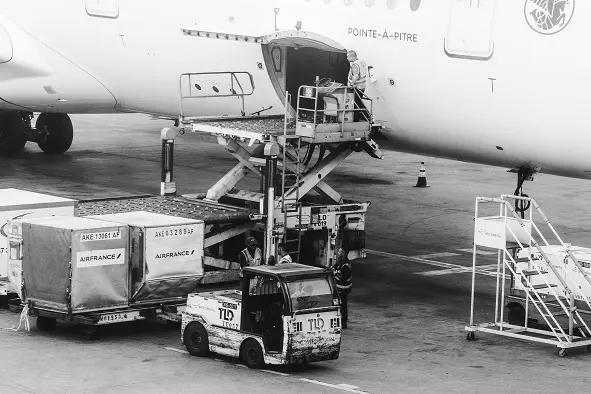
The booking process typically follows these steps:
- Initial inquiry – Provide cargo details (weight, dimensions, commodity type)
- Route specification – Departure and destination airports with timing requirements
- Quote comparison – Evaluate proposals from multiple operators
- Contract execution – Review terms, insurance coverage, and cancellation policies
- Cargo preparation – Ensure proper packaging and documentation
- Pre-flight coordination – Confirm loading procedures and security requirements
- Flight tracking – Monitor shipment progress
- Delivery confirmation – Verify receipt and condition
Working with experienced air charter brokers streamlines this process, as they maintain relationships with operators worldwide and handle logistics coordination on your behalf. Understanding air cargo customs clearance procedures is essential for international charters. You can also book a pickup
CHOOSE GLOBAL CHARTER FOR YOUR CARGO NEEDS
Selecting the right charter partner requires evaluating experience, aircraft access, and service quality beyond just price. Look for providers offering:
- 24/7 operations support for true emergency response
- Global network access to position aircraft efficiently
- Safety certifications meeting international standards (IATA, ICAO)
- Transparent pricing with detailed cost breakdowns
- Insurance expertise protecting high-value shipments
- Customs brokerage support for international movements
Industry-leading charter operators maintain safety ratings from aviation authorities and carry comprehensive insurance protecting your cargo throughout the journey. Verify operator credentials through resources like the Air Charter Association or National Air Transportation Association.
For comprehensive logistics support beyond air charter, explore custom clearance services, sea freight, and road express options that complement your air cargo strategy. The development of Egyptian air shipping demonstrates how integrated logistics solutions enhance supply chain efficiency.
Need Help Calculating Your Charter Costs?
Chat with Our Team on WhatsApp
Start a WhatsApp conversation to receive instant pricing quotes, personalized aircraft recommendations, and expert guidance on optimizing your cargo plane charter budget.
2025 Market Trends & Future Outlook
Cargo Charter Market Trends in 2025
Understanding current market dynamics helps businesses anticipate pricing changes and strategic opportunities in cargo charter operations.
Fleet Transformation
Widebody Freighter Evolution:
The global cargo charter fleet is undergoing significant transformation in 2025:
- Boeing 747F phase-out acceleration: 15-20 retirements annually as operators transition to more efficient aircraft
- Boeing 777F expansion: Fleet growing 8-12% annually, becoming the new long-haul standard
- Converted freighters: Strong market for passenger-to-freighter conversions (737-800BCF, A330P2F, 767-300BCF)
- Regional jet growth: Increased investment in smaller dedicated freighters for express networks
Impact on Charter Rates:
- 747F rates increasing 8-12% annually due to scarcity
- 777F rates stabilizing as fleet availability improves
- Converted freighter rates 15-25% below factory-built equivalents
Sustainability Requirements
Environmental Regulations Affecting Charter Costs:
EU Emissions Trading System (ETS) Expansion:
- Cargo flights to/from EU airports now subject to carbon pricing
- Average cost impact: $3,000-$12,000 per transatlantic flight
- Drives preference for fuel-efficient aircraft (777F vs 747F)
Carbon Offset Programs:
- Corporate ESG commitments driving voluntary offset purchases
- Cost: $15-$40 per metric ton of CO2
- Typical transoceanic charter: 300-500 tons CO2
- Additional cost: $4,500-$20,000 per flight
Sustainable Aviation Fuel (SAF) Premiums:
- SAF costs 150-300% more than conventional jet fuel
- Limited availability in 2025 (≈2% of total fuel supply)
- Charter customers requesting SAF: 5-10% premium over standard fuel cost
Future Outlook: Environmental compliance costs expected to add 8-15% to charter prices by 2027 as regulations tighten.
Technology Integration
Digital Transformation in Charter Operations:
Real-Time Pricing Platforms:
- Instant quote systems reducing booking friction
- Transparent rate comparison across multiple operators
- Estimated market penetration: 35-40% of charter bookings in 2025
Advanced Tracking Systems:
- IoT sensors providing real-time location, temperature, and condition monitoring
- Reduces cargo damage claims by 25-35%
- Standard on 60%+ of modern freighter fleet
Predictive Maintenance:
- AI-driven aircraft health monitoring reducing unscheduled downtime
- Improves charter reliability (95%+ on-time performance)
- Reduces maintenance-related pricing volatility
Blockchain Documentation:
- Digital air waybills and customs documentation
- Reduces processing time 40-60%
- Lowers administrative costs ($500-$2,000 per shipment)
E-Commerce Impact
Peak Season Capacity Constraints:
E-commerce growth continues driving charter demand:
2024 Peak Season (Q4) Statistics:
- Global air cargo capacity shortfall: 18-22% versus demand
- Charter rates premium: 35-50% above baseline
- Average booking lead time: Reduced from 10 days to 4 days
2025 Projections:
- E-commerce air freight growth: 12-15% year-over-year
- Charter market growth: 8-10% annually
- Peak season capacity gap: Persisting through 2026-2027
Strategic Implications:
- Earlier peak season bookings essential (book September for November flights)
- Long-term charter contracts becoming more valuable
- Regional distribution models reducing reliance on long-haul charters
Geopolitical Factors
Route Disruptions Affecting Charter Pricing:
Airspace Restrictions:
- Continued closures over conflict zones (Ukraine, parts of Middle East)
- Forces longer routing, increasing flight time 10-25%
- Adds $15,000-$80,000 to affected charter costs
Trade Policy Changes:
- Tariff uncertainties driving inventory frontloading
- Increased charter demand for strategic positioning
- Price volatility: ±15-20% based on trade negotiations
Infrastructure Development:
- New cargo airports in Asia and Middle East increasing capacity
- Improves competition and routing options
- Moderating price pressure in developing regions
Conclusion
Understanding cargo plane charter cost empowers businesses to make informed decisions when urgent shipping needs arise. While charter rates reflect the premium nature of dedicated aircraft service, the flexibility, speed, and reliability often deliver ROI that justifies the investment.
By selecting appropriate aircraft, optimizing routing, and building strategic partnerships with charter operators, companies can manage logistics budgets effectively while maintaining supply chain agility. Whether shipping emergency medical supplies or keeping production lines running, air cargo charter remains an essential tool in modern logistics management.
Ready to explore charter options for your next urgent shipment? Contact experienced air charter specialists who can provide detailed quotes tailored to your specific requirements and help you navigate the complexities of cargo plane charter cost. Visit our resources page for additional shipping guides and forms & documents to streamline your logistics operations.
FAQs:
Q: How much does it cost to charter a cargo plane?
Cargo charter costs range from $5,000 to $800,000+ per flight depending on aircraft size, distance, and requirements:
- Small aircraft (regional, <500 miles): $5,000-$20,000
- Medium aircraft (1,000 miles): $25,000-$80,000
- Large aircraft (2,500 miles): $100,000-$250,000
- Heavy aircraft (transoceanic): $300,000-$800,000+
Total cost includes base flight hours, positioning fees, landing charges, handling, fuel surcharges, and insurance. Request detailed quotes for your specific route and cargo.
Q: What is the Boeing 777F charter cost per hour?
Boeing 777F charter rates range from $35,000 to $55,000 per flight hour in 2025. Total charter costs vary significantly:
- Short-haul (2-4 hours): $150,000-$300,000
- Medium-haul (6-8 hours): $300,000-$500,000
- Long-haul (10-14 hours): $500,000-$850,000
These estimates include positioning, landing fees, handling, and fuel. The 777F offers superior fuel efficiency and 224,900 lbs payload capacity, making it cost-effective for transoceanic heavy shipments.
Q: How much is Boeing 747 freighter charter cost per hour in 2025?
Boeing 747-400F charter cost per hour 2025 ranges from $30,000 to $50,000 depending on market conditions and operational requirements. Complete charter costs typically include:
- Base hourly rate: $30,000-$50,000/hour
- Additional costs: 40-60% of base rate
- Peak season premium: 20-35% increase (October-December)
The 747-400F provides maximum payload (248,600 lbs) and nose-loading capability for oversized cargo. With declining fleet availability, rates have increased 8-12% compared to 2024.
Q: What are cargo aircraft charter rates for different plane sizes?
Cargo aircraft charter rates by category (per flight hour):
Small Aircraft: $1,500-$4,000/hour
- Cessna Caravan, Pilatus PC-12
- Payload: 2,500-4,500 lbs
Medium Aircraft: $4,000-$18,000/hour
- Boeing 737F, Airbus A300F
- Payload: 22,000-110,000 lbs
Large Aircraft: $18,000-$35,000/hour
- Boeing 767F, Airbus A330F
- Payload: 127,000-154,000 lbs
Heavy Aircraft: $30,000-$65,000/hour
- Boeing 777F, 747-400F, Antonov An-124
- Payload: 224,900-330,000 lbs
Rates vary by distance, urgency, season, and market availability.
Q: How much does a cargo plane cost to purchase?
New cargo aircraft purchase prices:
- Small turboprops: $2-8 million (Cessna Caravan, Pilatus PC-12)
- Regional jets: $25-50 million (Boeing 737-800BCF conversion)
- Widebody freighters: $200-400 million (Boeing 777F, 747-8F new)
Used cargo aircraft range from $5 million (older 737F) to $80 million (late-model 747F). Most businesses charter rather than purchase due to:
- High acquisition costs ($50-400 million)
- Maintenance expenses ($3-8 million annually)
- Crew salaries ($500,000+ annually per aircraft)
- Insurance and regulatory compliance costs
- Depreciation and obsolescence risk
Chartering provides flexibility without capital investment or operational overhead.
Q: How much to charter a 3-hour cargo flight?
A three-hour cargo charter costs between $15,000-$180,000 depending on aircraft type:
- Small turboprop: $15,000-$25,000 total
- Medium jet (Boeing 737F): $35,000-$60,000 total
- Large jet (Boeing 767F): $75,000-$120,000 total
- Heavy jet (Boeing 777F): $140,000-$220,000 total
These estimates include flight time, positioning (if minimal), landing fees, and handling. Add 30-50% for significant repositioning, special handling, or peak season premiums.
Q: What factors affect cargo plane charter costs the most?
The five biggest cost drivers for cargo charters:
- Aircraft size/type (40-50% of cost variation)
- Larger aircraft command exponentially higher hourly rates
- Specialized aircraft (temperature-controlled, oversized capacity) add premiums
- Distance/flight time (25-35% of cost variation)
- Longer flights accumulate more hourly charges
- Fuel consumption increases proportionally with distance
- Positioning/repositioning (15-25% of cost)
- Empty aircraft movement to/from your departure point
- Can double total cost if aircraft is far from your location
- Urgency/timing (10-20% of cost)
- Same-day requests: 30-50% premium
- Peak season (Q4): 25-40% increase
- Off-peak periods: 10-15% potential discount
- Route complexity (5-15% of cost)
- Remote destinations: limited infrastructure, higher fees
- International flights: permits, customs, overflight charges
- Multiple stops: additional landing/handling fees per stop
Q: How can I reduce cargo charter costs without sacrificing service?
Ten proven cost-reduction strategies:
- Book in advance: 7-14 days notice saves 15-25% versus spot market
- Optimize aircraft selection: Right-size aircraft to your cargo (don’t overpay for unused capacity)
- Flexible departure timing: Off-peak hours and days reduce premiums
- Consolidate shipments: Combine multiple urgent items into single charter
- Choose strategic airports: Cargo hubs with existing aircraft reduce positioning fees
- Negotiate volume agreements: Commit to 5-10 annual charters for 10-20% discount
- Consider part-charter: Share aircraft space for 40-60% savings when viable
- Plan around aircraft positioning: Utilize operators’ empty repositioning flights
- Evaluate scheduled alternatives: Next-flight-out service may suffice for some urgencies
- Build broker relationships: Experienced brokers access competitive rates across multiple operators
Q: When does cargo charter make financial sense despite high costs?
Charter becomes cost-effective when downtime costs exceed charter investment. Key ROI scenarios:
Production Continuity:
- Manufacturing line shutdown costs: $50,000-$500,000+ per hour
- Charter cost: $50,000-$200,000
- ROI: Preventing 2-10 hours of downtime justifies charter
Contract Fulfillment:
- Missing delivery deadline risks contract cancellation
- Contract value: $1-50 million
- Penalty clauses: 10-30% of contract value
- Charter cost: $100,000-$500,000
- ROI: Charter preserves relationship and prevents penalties
Market Opportunity:
- Limited-time sales opportunity or competitive advantage
- Revenue potential: $500,000-$10+ million
- Charter enables market capture competitors cannot match
- ROI: 5-50× return on charter investment
Emergency Response:
- Disaster relief, medical emergencies, critical infrastructure repair
- Human life, public safety, or humanitarian considerations
- Charter provides only viable rapid response
- ROI: Immeasurable (lives saved, suffering prevented)
Inventory Optimization:
- Reduces warehouse costs and capital tied in excess inventory
- Just-in-time delivery via charter: $100,000-$300,000
- Quarterly inventory carrying cost savings: $150,000-$500,000
- ROI: Charter pays for itself through inventory reduction
Q: What’s included in a cargo charter quote, and what are hidden fees?
Typically Included in Base Quote:
- Aircraft hourly operating rate
- Standard crew costs (pilots, flight engineer)
- Basic insurance coverage
- Standard ground handling equipment
- Routine landing/takeoff procedures
Additional Costs Usually NOT Included (Ask Specifically):
- Positioning fees: Aircraft movement to your departure point ($20,000-$150,000+)
- Airport landing fees: Variable by airport size ($2,000-$15,000 per airport)
- Handling charges: Loading/unloading equipment ($3,000-$12,000)
- Fuel surcharges: Fluctuates with oil prices (10-25% of base cost)
- Crew overnight expenses: If multi-day operations ($500-$2,000 per day)
- Special equipment: Temperature control, oversized cargo handling ($2,000-$10,000)
- Insurance riders: High-value or hazmat cargo ($2,000-$15,000)
- Customs/permits: International flight documentation ($1,500-$8,000)
- Security screening: Enhanced cargo inspection ($1,000-$5,000)
- After-hours premiums: Weekend or night operations (15-30% surcharge)
- Waiting time: Aircraft delays beyond scheduled loading ($1,500-$5,000 per hour)
- Cancellation fees: Last-minute booking changes (25-100% of charter cost)
Best Practice: Request “all-in” quotes that itemize every cost component to avoid surprises.
Q: How far in advance should I book a cargo charter?
Optimal booking timelines:
Emergency Charter (0-24 hours notice):
- Cost impact: 30-50% premium above standard rates
- Availability: Limited to aircraft currently in nearby locations
- When necessary: Production emergencies, critical deadline failures, disaster response
Urgent Charter (1-7 days notice):
- Cost impact: 15-25% premium above advance booking
- Availability: Moderate selection, some positioning required
- When appropriate: Supply chain disruptions, unexpected demand spikes
Standard Charter (7-14 days notice):
- Cost impact: Standard market rates
- Availability: Full aircraft selection, optimal routing
- When ideal: Planned shipments, known capacity constraints
- Savings: 20-30% versus emergency booking
Advance Charter (14+ days notice):
- Cost impact: 10-15% below standard rates (potential negotiation leverage)
- Availability: Maximum flexibility, can schedule around aircraft positioning
- When ideal: Seasonal planning, contracted movements, regular operations
- Savings: 35-45% versus emergency booking
Strategic Planning: Anticipate likely charter needs quarterly and establish framework agreements with operators for guaranteed availability and preferred pricing.
Q: Can I share a cargo charter with other companies to reduce costs?
Yes, part-charter (also called charter-sharing or split-charter) offers significant savings:
How Part-Charter Works:
- Charter broker consolidates cargo from multiple shippers onto single aircraft
- Each shipper pays proportionally based on weight/space utilized
- Typical cost: 30-50% of full charter price for your portion
- Consolidation time: 2-5 days for broker to fill aircraft
Ideal Scenarios for Part-Charter:
- Your cargo fills <60% of aircraft capacity
- 3-5 day timeline acceptable (allows broker to consolidate)
- Major trade lanes (US-Europe, Asia-US, intra-Europe)
- No exclusive security or handling requirements
- Standard commodity (non-hazmat, non-perishable)
Part-Charter Example:
- Your cargo: 60,000 lbs Los Angeles to Frankfurt
- Aircraft: Boeing 747-400F (248,000 lbs capacity)
- Your utilization: 24% of aircraft capacity
- Full charter cost: $420,000
- Part-charter cost: $130,000-$160,000 (31-38% of full cost)
- Savings: $260,000-$290,000
Limitations:
- Not available for remote routes or uncommon destinations
- Requires flexibility on exact departure date/time
- Less control over routing and handling procedures
- May not be available during peak demand periods
Alternative: Next-flight-out scheduled freighter service offers guaranteed space at even lower costs for non-urgent shipments.