Importing goods by sea involves multiple stages, from booking cargo space to final delivery. Understanding the sea import procedure helps businesses avoid costly delays, reduce demurrage charges, and ensure smooth customs clearance. This guide walks you through each step of the import sea shipment procedure, complete with timelines, required documents, and expert tips for successful ocean freight imports.
Understanding Sea Freight Imports: The Foundation
The sea import process involves coordinating between multiple parties: your supplier, freight forwarder, shipping line, customs authorities, and port operators. Unlike air freight, ocean shipping offers cost-effective solutions for large volumes but requires longer lead times and more complex documentation.
Key players in the sea import procedure:
- Shipper/Exporter: Your overseas supplier
- Freight Forwarder: Coordinates the entire sea freight journey
- Shipping Line: Operates the vessel transporting your cargo
- Customs Broker: Handles custom clearance formalities
- Port Authority: Manages port operations and cargo handling
FCL vs LCL: Choosing Your Shipping Method
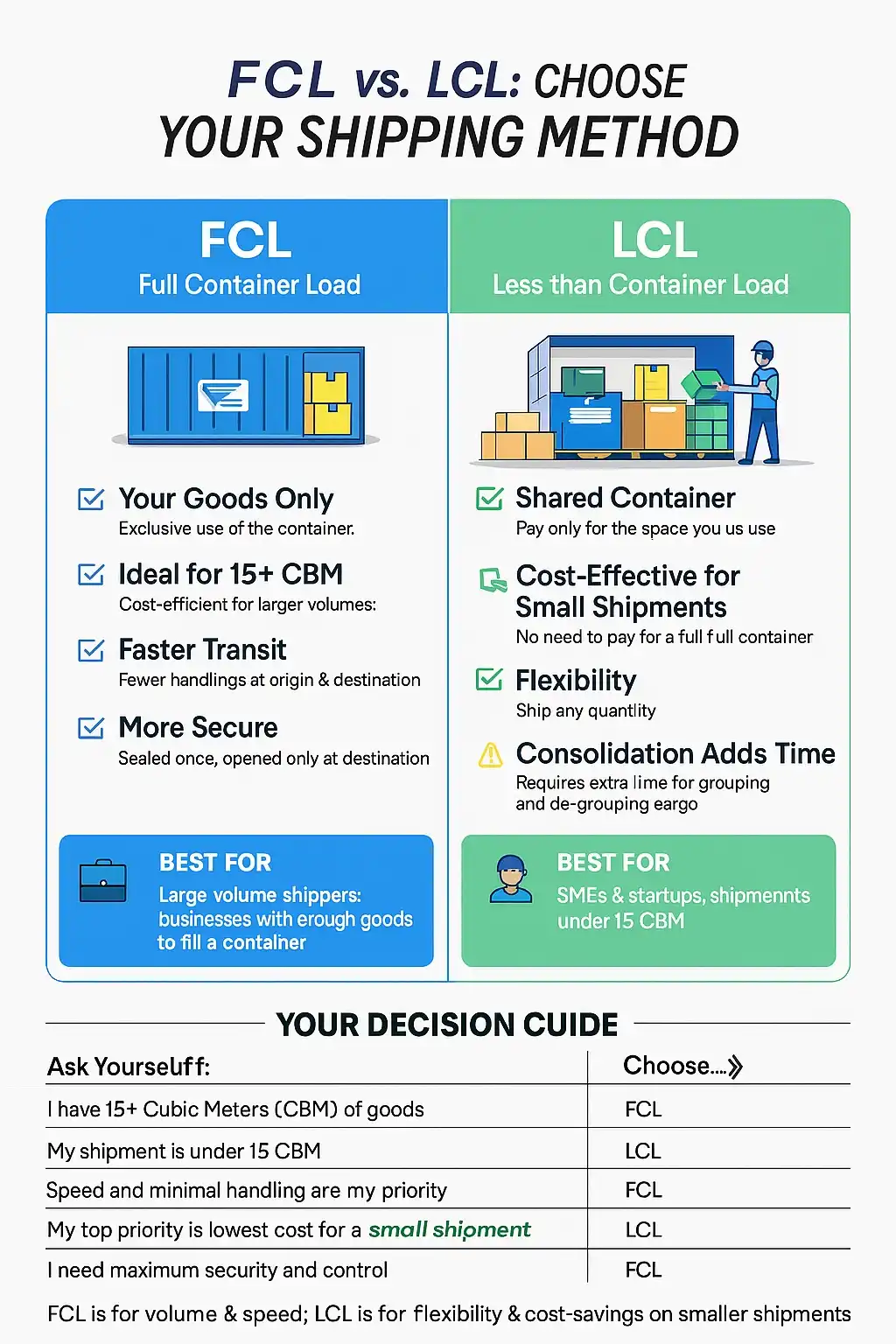
Before starting the import sea shipment procedure, decide between Full Container Load (FCL) and Less than Container Load (LCL). FCL works for businesses shipping 15+ cubic meters, while LCL consolidation services suit smaller shipments. According to the World Shipping Council, approximately 60% of global containerized trade uses FCL.
Average sea import process timeline:
- Documentation preparation: 2-5 days
- Ocean transit: 15-45 days (route-dependent)
- Customs clearance: 2-7 days
- Final delivery: 1-3 days
- Total: 20-60 days
Step 1: Booking & Documentation Preparation

The sea import procedure begins with securing cargo space and preparing essential documents. This stage determines whether your shipment arrives on schedule or faces delays at customs.
Booking Your Sea Freight Shipment
Contact a reliable freight forwarder in Egypt to:
- Negotiate competitive ocean freight rates
- Confirm vessel schedule and transit time
- Agree on Incoterms (FOB, CIF, or CFR)
- Reserve container space (critical during peak seasons)
Pro tip: Book 2-3 weeks ahead during high-demand periods (September-November, Chinese New Year).
Essential Documents for Sea Import Documentation Procedure
Your sea import documentation procedure requires these critical papers:
| Document | Purpose | Issued By |
| Commercial Invoice | Declares cargo value for customs | Supplier |
| Packing List | Details contents, weights, dimensions | Supplier |
| Bill of Lading (B/L) | Proof of cargo ownership & receipt | Shipping Line |
| Certificate of Origin | Proves manufacturing country | Chamber of Commerce |
| Insurance Certificate | Covers cargo against loss/damage | Insurance Company |
| Purchase Order | Confirms transaction details | Buyer |
The International Chamber of Commerce provides standardized templates for these documents, ensuring compliance across borders.
Common mistake to avoid: Mismatched details between commercial invoice and packing list cause 40% of customs delays, according to trade compliance data.
Step 2: Cargo Loading & Departure from Origin Port
Once documentation is complete, the ocean import procedure moves to the physical loading stage.
Container Stuffing Process
For FCL shipments:
- Empty container delivered to supplier’s facility
- Goods loaded and secured inside container
- Container seal applied (recorded on B/L)
- Container transported to origin port
For LCL shipments, your cargo joins other shippers’ goods at the freight consolidation warehouse.
VGM Compliance Requirements
Since the SOLAS Convention amendments, all containerized cargo requires Verified Gross Mass (VGM) submission. Your supplier or freight forwarder must:
- Weigh the packed container
- Submit VGM to shipping line 24-48 hours before vessel cutoff
- Include VGM on shipping instructions
Timeline: Container loading to vessel departure typically takes 3-7 days.
Bill of Lading Issuance
The shipping line issues the Bill of Lading in three forms:
- Original B/L: Required for cargo release (sent via courier)
- Sea Waybill: Faster alternative, no original needed
- Telex Release: Electronic B/L surrender
Critical: Never accept a Bill of Lading without verifying container seal number, cargo description, and shipping terms match your purchase order.
Step 3: Ocean Transit & Real-Time Tracking
During the sea import process, your cargo crosses international waters. Modern technology makes this traditionally opaque stage transparent.
Typical Transit Times by Major Routes
| Origin | Destination | Transit Time |
| Shanghai, China | Alexandria, Egypt | 28-35 days |
| Hamburg, Germany | Port Said, Egypt | 8-12 days |
| Jebel Ali, UAE | Sokhna, Egypt | 5-7 days |
| Los Angeles, USA | Alexandria, Egypt | 35-42 days |
Transit times vary based on:
- Direct vs. transshipment routes
- Weather conditions and sea states
- Port congestion at intermediate stops
- Vessel speed (typically 18-25 knots)
Monitoring Your Shipment
Professional freight forwarders offer real-time tracking systems that show:
- Current vessel position via AIS data
- Estimated arrival time updates
- Port call schedules
- Delay notifications
What you should do during transit:
- Monitor vessel progress weekly
- Prepare import documents for customs
- Confirm Letter of Credit payment terms
- Arrange destination port services
- Plan warehouse space for cargo receipt
The growth of Egyptian sea shipping has improved connectivity between major trade routes, reducing average transit times by 15% since 2020.
Step 4: Arrival Notice & Pre-Clearance Preparation
Seven to ten days before your container reaches port, the shipping line issues an Arrival Notice. This triggers the critical pre-clearance phase of the sea import procedure.
Receiving and Acting on Arrival Notice
The Arrival Notice contains:
- Vessel name and voyage number
- Expected arrival date at destination port
- Container number and seal details
- Cargo description and weight
- Demurrage-free time allowance (usually 3-7 days)
Immediate action required: Forward this notice to your customs clearance agent within 24 hours.
Submitting Import Declaration
The procedure of import trade requires filing a customs declaration before or immediately upon vessel arrival. In Egypt, this involves the NAFEZA single-window system.
Documents needed for customs submission:
✓ Original Bill of Lading or Telex Release
✓ Commercial invoice (showing correct HS codes)
✓ Detailed packing list
✓ Certificate of Origin
✓ Import permit or license (if applicable)
✓ Product certificates (health, quality, conformity)
✓ Tax registration/Importer ID
✓ Insurance certificate
HS Code Classification
Accurate Harmonized System (HS) code classification determines:
- Applicable customs duty rates
- Import restrictions or requirements
- Statistical tracking categories
According to the World Customs Organization, incorrect HS codes account for 65% of customs disputes. Cross-reference your goods against the Egyptian Customs Tariff or consult your freight forwarder.
Pro tip: Submit your customs declaration 2-3 days before vessel arrival to enable pre-clearance and avoid demurrage charges.
Step 5: Customs Clearance & Physical Inspection
This stage of the sea import documentation procedure determines how quickly your cargo exits the port. Understanding customs processes prevents costly delays.
Customs Risk Assessment Channels
Most countries, including Egypt, use a three-channel risk system:
| Channel | Inspection Level | Clearance Time | Selection Rate |
| Green | Documentary only | 1-2 days | ~60% |
| Yellow | Document review + verification | 2-4 days | ~30% |
| Red | Full physical inspection | 4-7 days | ~10% |
Selection depends on:
- Importer’s compliance history
- Commodity risk profile
- Declared value accuracy
- Random selection protocols
Duty & Tax Calculation
Your customs broker calculates payable amounts based on:
Formula: Total Duties = (CIF Value × Duty Rate) + VAT + Other Fees
CIF Value components:
- Cost of goods (invoice value)
- Insurance charges (minimum 1% of FOB)
- Freight charges to destination port
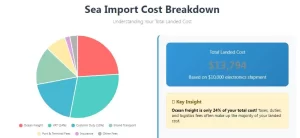
Example calculation for $10,000 electronics shipment:
CIF Value: $10,000 + $200 (insurance) + $800 (freight) = $11,000
Customs Duty (10%): $1,100
Subtotal: $12,100
VAT (14%): $1,694
Total payable: $13,794
Physical Inspection Process
If selected for red channel inspection:
- Container positioning: Moved to examination area
- Opening & destuffing: Supervised by customs officers
- Sample testing: For regulated goods (electronics, food, textiles)
- Documentation verification: Physical count vs. packing list
- Re-stuffing & sealing: Container secured after inspection
Common inspection triggers:
- First-time importer status
- High-value luxury goods
- Restricted or regulated commodities
- Significant price discrepancies
- Incomplete documentation
Customs Payment Methods
Pay duties and taxes through:
- Bank transfer to customs authority
- Customs-approved payment platforms
- Bonded warehouse arrangements (deferred payment)
Timeline: Green channel clearance takes 1-2 days, while red channel inspections extend to 5-7 days depending on port congestion and testing requirements.
According to World Bank Logistics Performance Index, Egypt’s customs clearance efficiency improved 23% between 2020-2024, reducing average clearance times from 6 days to 4.5 days.
Step 6: Port Handling & Container Release
After customs clearance approval, the ocean import procedure moves to port terminal operations and container gate-out.
Port Charges & Fees Structure
Beyond customs duties, expect these port-related charges:
Mandatory port fees:
- Terminal Handling Charges (THC): $150-400 per container
- Documentation fees: $50-150
- Bill of Lading release: $30-80
- Container examination fee (if inspected): $100-200
- Weighbridge charges: $20-50
Storage-related charges:
- Free time: Typically 3-7 days (varies by shipping line)
- Demurrage: $50-150 per container per day after free time
- Detention: $75-200 per day (if container not returned on time)
Real scenario: A 40ft container left at port for 10 days beyond free time accumulates approximately $500-1,500 in demurrage charges—often more than the original freight cost for short routes.
Obtaining Delivery Order (D/O)
The Delivery Order authorizes container release from port. To obtain it:
- Submit customs clearance certificate to shipping line
- Pay all port and shipping line charges
- Present original Bill of Lading (or confirm Telex Release)
- Receive D/O from shipping line office or agent
Digital transformation: Egyptian ports increasingly offer electronic D/O systems through the NAFEZA platform, reducing processing time from 4-6 hours to under 1 hour.
Container Gate-Out Process
With D/O in hand, your trucking company:
- Presents D/O at port gate
- Port authority verifies container seal integrity
- Gate pass issued for container exit
- Truck loaded and exits port facility
- Container GPS tracking activated
Pro tip: Schedule gate-out during off-peak hours (early morning or late afternoon) to avoid 2-4 hour queues during midday rush.
Understanding Demurrage vs. Detention
Many importers confuse these terms:
| Charge Type | Applies To | Clock Starts | Clock Stops |
| Demurrage | Container at port/terminal | End of free time | Container gate-out |
| Detention | Container outside port | Container gate-out | Empty return to depot |
Combined free time for demurrage and detention typically ranges 7-14 days total. Exceeding this substantially increases costs.
Timeline: From customs approval to container gate-out takes 1-2 days for routine shipments, or up to 5 days during port congestion periods.
Step 7: Final Delivery to Your Destination
The final stage of the sea import procedure brings your cargo from port to warehouse, factory, or distribution center.
Inland Transportation Options
Choose from three delivery models:
- Door-to-Door Service (Recommended)
- Freight forwarder coordinates entire journey
- Single point of contact and liability
- Includes trucking, container destuffing, empty return
- Cost: Freight rate + 15-25% premium
- Best for: First-time importers, high-value cargo
- Port-to-Door Service
- You arrange customs clearance
- Freight forwarder handles inland transport only
- Cost: Lower than door-to-door
- Best for: Experienced importers with customs expertise
- Ex-Works Port (Self-Pickup)
- You handle everything after customs clearance
- Arrange own trucking and container handling
- Cost: Lowest total cost
- Best for: Local businesses with logistics capabilities
Container Destuffing & Cargo Receipt
Upon delivery to your facility:
For FCL shipments:
- Container positioned at unloading bay
- Seal number verified against D/O
- Container doors opened and contents inspected
- Goods unloaded (typically 2-4 hours for 40ft container)
- Cargo inspected for damage
- Delivery receipt signed
For LCL shipments:
- Goods typically destuffed at CFS (Container Freight Station)
- Your cargo delivered loose via road express services
- Smaller volume, easier handling
Empty Container Return
FCL importers must return empty containers to shipping line depot within detention-free period:
Standard detention-free time: 3-7 days after container gate-out
Empty return process:
- Clean container interior (remove debris, pallets)
- Transport to designated empty depot
- Submit container at depot gate
- Receive empty return receipt
- Confirm detention charges cleared
Late return penalty: Detention charges accrue at $75-200 per day, sometimes doubling after 10 days. According to industry data, 30% of importers incur unnecessary detention fees due to poor planning.
Cargo Inspection & Claims
Inspect your goods immediately upon receipt:
Check for:
- Physical damage (wet, crushed, torn packaging)
- Quantity shortages vs. packing list
- Product quality issues
- Expiry dates (for perishables)
Filing damage claims:
- Document with photos and videos
- Note discrepancies on delivery receipt
- Contact freight forwarder within 24 hours
- File claim with cargo insurance provider within 7 days
Timeline: Final delivery from port gate-out to your facility takes 1-3 days depending on distance and traffic conditions. Within Egypt, Alexandria port to Cairo typically requires 4-6 hours transit.
Complete Sea Import Procedure Timeline Overview
Understanding the full import sea shipment procedure timeline helps you plan inventory and cash flow effectively.
End-to-End Timeline Breakdown
| Phase | Activities | Duration | Cumulative Time |
| Pre-Shipment | Booking, documentation | 2-5 days | 2-5 days |
| Origin Operations | Loading, VGM, departure | 3-7 days | 5-12 days |
| Ocean Transit | Sailing time | 15-45 days | 20-57 days |
| Arrival & Pre-Clearance | Notice, customs filing | 1-3 days | 21-60 days |
| Customs Clearance | Review, inspection, payment | 2-7 days | 23-67 days |
| Port Operations | D/O, gate-out | 1-2 days | 24-69 days |
| Final Delivery | Transport, destuffing | 1-3 days | 25-72 days |
Realistic average: 35-45 days for most China-Egypt shipments
Best case scenario: 25-30 days (direct route, green channel clearance)
Worst case scenario: 60-75 days (transshipment, red channel inspection, port congestion)
Factors That Extend Your Timeline
Shipping-related delays (5-15 days):
- Vessel schedule changes or cancellations
- Port congestion at transshipment hubs
- Weather delays (typhoons, storms)
- Suez Canal queuing during peak periods
Documentation delays (3-10 days):
- Missing or incorrect certificates
- HS code classification disputes
- Valuation disagreements with customs
- Import permit processing
Inspection delays (2-5 days):
- Laboratory testing for regulated goods
- Additional document requests
- Physical inspection queues
Operational delays (2-7 days):
- Payment processing delays
- Trucking unavailability
- Warehouse receiving capacity
Pro tip: Build 10-15 days buffer into your supply chain planning for the sea import process. According to logistics industry benchmarks, only 70% of sea freight shipments arrive within the estimated window.
Common Challenges in Sea Import Procedure & Expert Solutions
Even experienced importers face obstacles during the procedure of import. Here’s how to overcome the most frequent issues.
Challenge 1: Documentation Errors & Mismatches
Problem: Discrepancies between commercial invoice, packing list, and Bill of Lading trigger customs holds.
Common errors:
- Mismatched HS codes across documents
- Incorrect货物 descriptions or quantities
- Wrong Incoterms listed
- Missing mandatory certificates
- Invoice value discrepancies
Solution: ✓ Implement document verification checklist before shipment
✓ Use standardized templates provided by freight forwarders
✓ Triple-check HS codes against official tariff schedules
✓ Request document pre-clearance review from customs broker
✓ Maintain consistent product descriptions across all paperwork
Impact: Proper documentation reduces clearance time by 40% and eliminates 90% of customs disputes.
Challenge 2: Customs Valuation Disputes
Problem: Customs authorities question declared cargo values, suspecting undervaluation.
Triggers:
- Prices significantly below market rates
- Inconsistent pricing across shipments
- Lack of supporting evidence (quotations, contracts)
- Previous violations by importer
Solution: ✓ Maintain detailed price justification files
✓ Include purchase orders and supplier quotations
✓ Provide brand certificates for genuine goods
✓ Use arm’s length pricing for related-party transactions
✓ Consider AEO (Authorized Economic Operator) certification
Expert tip: The WTO Valuation Agreement protects importers who maintain transparent documentation. Build a compliance file for each shipment.
Challenge 3: Demurrage & Detention Charges
Problem: Port storage fees and container detention accumulate rapidly, often exceeding freight costs.
Root causes:
- Delayed customs clearance approvals
- Cash flow issues preventing duty payment
- Trucking unavailability for container pickup
- Warehouse not ready for cargo receipt
Solution: ✓ Start customs clearance process 3-5 days before arrival
✓ Pre-arrange duty payment through customs broker
✓ Book trucking 48 hours before clearance completion
✓ Negotiate extended free time with shipping line (possible for regular customers)
✓ Use bonded warehouse option if immediate payment difficult
Cost savings: Avoiding just 5 days of demurrage saves $250-750 per container—money better spent on your business growth.
Challenge 4: Communication Gaps & Visibility Issues
Problem: Lack of real-time information about shipment status causes planning difficulties.
Manifestations:
- Surprise arrival dates
- Unknown customs holds
- Unclear charge breakdowns
- Lost documentation
Solution: ✓ Choose freight forwarders with modern tracking technology
✓ Request daily status updates during customs phase
✓ Implement milestone notifications (vessel arrival, clearance approval, gate-out)
✓ Use shared document platforms (Google Drive, cloud systems)
✓ Establish primary contact person for all communications
Technology advantage: Digital freight platforms reduce communication errors by 85% compared to email-only coordination.
Challenge 5: Regulatory Compliance for Restricted Goods
Problem: Certain products require special permits, testing, or documentation.
Regulated categories:
- Electronics (NTRA certification in Egypt)
- Food & beverages (health ministry approval)
- Pharmaceuticals (drug registration)
- Textiles (origin verification)
- Chemicals (safety data sheets)
Solution: ✓ Research import requirements 4-6 weeks before shipment
✓ Apply for permits early (processing takes 2-4 weeks)
✓ Work with specialized customs clearance agents for regulated goods
✓ Maintain updated list of country-specific requirements
✓ Consider pre-shipment inspection (PSI) services
Compliance tip: The Egyptian Organization for Standards & Quality publishes updated lists of products requiring conformity certificates.
Ready to simplify your sea freight imports?
Chat with Our Team on WhatsApp
GCT Freight’s team brings decades of combined experience in Egyptian customs procedures, international shipping regulations, and end-to-end logistics coordination
Sea Import Procedure Checklist: Your Action Plan
Use this comprehensive checklist to manage every phase of the sea import documentation procedure efficiently.
Phase 1: Pre-Shipment Preparation (2-5 Days Before Loading)
Booking & Agreements:
- Request freight quotes from minimum 3 forwarders
- Confirm Incoterms with supplier (FOB, CIF, CFR)
- Book cargo space with sea freight service
- Arrange cargo insurance (minimum 110% of CIF value)
- Verify vessel schedule and transit time
Documentation:
- Receive commercial invoice from supplier
- Obtain detailed packing list with HS codes
- Verify Certificate of Origin issuance
- Confirm product certificates (if required)
- Check all documents match purchase order
Financial:
- Arrange Letter of Credit or payment terms
- Budget for customs duties (calculate using HS codes)
- Reserve funds for port charges and VAT
- Confirm forex rates for payments
Phase 2: During Ocean Transit (15-45 Days)
Monitoring:
- Track vessel position weekly
- Receive and review arrival notice (ETA-7 days)
- Confirm container seal number on B/L
- Verify Bill of Lading details accuracy
Preparation:
- Appoint customs broker (if not included)
- Submit import documents for pre-clearance
- Arrange inland transportation
- Prepare warehouse for cargo receipt
- Confirm empty container return location
Phase 3: Arrival & Customs (2-7 Days After Vessel Arrival)
Customs Clearance:
- Submit customs declaration immediately
- Provide original B/L or confirm Telex Release
- Pay customs duties and VAT
- Pay port handling charges
- Attend inspection if required (red channel)
Documentation Review:
- Double-check HS code classifications
- Verify invoice values match market rates
- Ensure all certificates are valid
- Respond promptly to customs queries
Phase 4: Port Operations & Delivery (1-3 Days)
Container Release:
- Collect Delivery Order from shipping line
- Schedule gate-out during off-peak hours
- Verify container seal before acceptance
- Inspect for external container damage
Final Delivery:
- Coordinate trucking to your facility
- Prepare unloading equipment/labor
- Inspect cargo thoroughly upon arrival
- Sign delivery receipt with any noted damages
- Return empty container within free time
- Collect empty return receipt
Phase 5: Post-Delivery (Within 7 Days)
Financial Closeout:
- Verify all charges against initial quotation
- Check for unexpected fees or penalties
- Process payment to freight forwarder
- File expense reports
Documentation Archive:
- Store all import documents (7 years minimum)
- Update inventory management system
- Record actual vs. estimated costs
- Note lessons learned for next shipment
Claims & Follow-up:
- File insurance claims (if damage found)
- Report discrepancies to supplier
- Provide feedback to freight forwarder
- Update supplier evaluation scores
Continuous Improvement:
- Calculate total landed cost per unit
- Compare actual timeline vs. estimate
- Identify process bottlenecks
- Schedule review meeting with logistics team
Why Professional Sea Freight Services Matter
Navigating the complex procedure of import trade requires expertise, local knowledge, and established relationships. Professional freight forwarders transform a challenging process into a smooth operation.
Benefits of Expert Freight Forwarding
- Consolidated Shipping Rates
- Volume discounts from shipping lines
- Negotiated port handling fees
- Reduced insurance premiums through group policies
- Savings: 15-30% vs. booking directly
- Customs Compliance Expertise
- Accurate HS code classification
- Up-to-date regulatory knowledge
- Established customs authority relationships
- Pre-clearance services to avoid delays
- Result: 95% green channel clearance rate vs. 60% industry average
- End-to-End Visibility
- Real-time shipment tracking
- Proactive delay notifications
- Document status updates
- Centralized communication platform
- Advantage: Reduce planning uncertainty by 70%
- Risk Mitigation
- Cargo insurance arrangement
- Documentation error prevention
- Compliance violation protection
- Dispute resolution support
- Protection: Comprehensive coverage against common import challenges
- Local Market Knowledge
- Understanding of Egyptian customs practices
- Relationships with port authorities
- Knowledge of seasonal congestion patterns
- Experience with local regulations
- Value: Navigate Egyptian shipping complexities efficiently
GCT Freight: Your Sea Import Partner in Egypt
With specialized experience in the sea import process, GCT Freight offers comprehensive sea freight solutions including:
Complete Import Services:
- Door-to-door ocean freight forwarding
- FCL and LCL consolidation
- Professional customs clearance services
- Inland transportation via road express network
- Cargo insurance and claims management
Technology-Enabled Operations:
- Online shipment tracking portal
- Digital document management
- Automated customs filing
- Mobile notifications for key milestones
Industry Expertise:
- Import compliance consulting
- HS code classification support
- Regulatory requirement guidance
- Supplier coordination services
Ready to simplify your sea imports? Book a consultation with our freight specialists or explore our comprehensive resources for import documentation templates and guides.
FAQs:
Q1: How long does the complete sea import procedure take from booking to delivery?
A: The typical sea import process takes 25-60 days depending on your route and clearance efficiency. Here’s the breakdown: booking and documentation (2-5 days), ocean transit (15-45 days based on origin), customs clearance (2-7 days), and final delivery (1-3 days).
For example, shipments from China to Egypt average 35-40 days, while European origins take 15-25 days. Build 10-15 days buffer into your planning for unexpected delays like customs inspections or port congestion.
Q2: What documents are absolutely essential for sea import documentation procedure?
A: The six mandatory documents for the sea import documentation procedure are:
- Bill of Lading (B/L) – Proves cargo ownership and receipt
- Commercial Invoice – Details transaction value and terms
- Packing List – Specifies contents, weights, and dimensions
- Certificate of Origin – Confirms manufacturing country
- Import Permit/License – Required for regulated goods
- Customs Declaration – Filed electronically through NAFEZA in Egypt
Additional documents may include insurance certificates, product conformity certificates, health certificates (for food/pharma), and NTRA certification (for electronics in Egypt). Your customs clearance specialist can provide a checklist specific to your commodity type.
Q3: What’s the difference between FCL and LCL in the sea import process?
A: FCL (Full Container Load) means you rent an entire container (20ft or 40ft) for your exclusive use. Best for shipments over 15 cubic meters. You pay a flat rate regardless of space used, and your cargo isn’t handled during transit.
LCL (Less than Container Load) combines your goods with other shippers’ cargo in a shared container. Ideal for smaller shipments (1-15 cbm). You pay only for space used, but transit takes longer due to consolidation/deconsolidation at origin and destination.
For detailed guidance, read our article on FCL sea shipment procedures or explore non-containerized freight options.
Q4: How much does sea freight import cost, including all charges?
A: Total landed cost for the ocean import procedure includes:
Freight charges: $800-3,500 per container (20ft/40ft) depending on route
Customs duties: 0-30% of CIF value (based on HS code)
VAT: 14% in Egypt (applied on CIF + duties)
Port charges: $150-400 (Terminal Handling, documentation)
Inland transport: $100-500 (port to destination)
Miscellaneous: Insurance (1-2% of value), customs broker fees ($100-300)
Example: Importing $20,000 worth of textiles (10% duty) from China in 40ft container:
- Freight: $2,200
- Insurance: $220
- CIF Value: $22,420
- Duty (10%): $2,242
- VAT (14%): $3,453
- Port/misc: $600
- Total landed cost: $28,715 (43.6% markup)
Request a detailed quotation from GCT Freight for accurate costing based on your specific shipment.
Q5: What are demurrage and detention charges, and how can I avoid them?
A: Demurrage applies when your container remains at the port terminal beyond the free time (typically 3-7 days after vessel arrival). Charged at $50-150 per day.
Detention applies when you keep the container outside the port beyond agreed time after gate-out (typically 3-7 days). Charged at $75-200 per day.
How to avoid these costly fees:
✓ Start customs clearance process 3-5 days before arrival
✓ Pre-arrange payment of duties and taxes
✓ Book trucking 48 hours before container release
✓ Have warehouse ready for immediate cargo receipt
✓ Return empty container within detention-free period
✓ Negotiate extended free time with shipping line (for regular customers)
Pro tip: Combined demurrage and detention for just 10 extra days can cost $1,250-3,500—often more than the freight itself. Efficient planning with your freight forwarder eliminates 95% of these charges.
Q6: Can I track my sea freight shipment in real-time during the import process?
A: Yes, modern freight forwarders provide comprehensive tracking throughout the sea import procedure. Tracking capabilities include:
During ocean transit:
- Vessel position via AIS (Automatic Identification System)
- Port departure/arrival confirmations
- Estimated arrival time updates
- Delay notifications
During customs clearance:
- Declaration submission status
- Inspection channel assignment (green/yellow/red)
- Duty payment confirmations
- Release approval notifications
During final delivery:
- Container gate-out confirmation
- GPS tracking of inland transport
- Delivery appointment scheduling
- POD (Proof of Delivery) documentation
GCT Freight’s tracking technology provides 24/7 visibility through our online portal and mobile notifications. You’ll receive automatic updates at each milestone, eliminating the need for constant follow-up calls.
Q7: What happens if customs rejects or holds my shipment?
A: Customs holds occur in approximately 15-20% of shipments, usually due to documentation issues rather than actual violations. Common reasons and solutions:
Documentation discrepancies:
- Issue: Mismatched information across documents
- Solution: Submit corrected documents within 24-48 hours; customs may request supporting evidence
Valuation disputes:
- Issue: Declared value questioned as too low
- Solution: Provide purchase orders, quotations, supplier invoices, brand certificates
Missing permits:
- Issue: Regulated goods without required licenses
- Solution: Apply for retroactive permit (if possible) or consider re-exportation
HS code disagreements:
- Issue: Classification dispute affecting duty calculation
- Solution: Provide product specifications, technical data sheets; may need to accept customs’ classification
Prohibited items:
- Issue: Goods violate import restrictions
- Solution: Re-export or destroy at your expense (rare but serious)
Timeline: Most holds are resolved within 3-7 days with proper documentation. Your customs clearance agent acts as liaison with authorities to expedite resolution.
Financial impact: Storage charges continue during holds, so prompt response is critical. Professional freight forwarders can often prevent holds through pre-clearance document review.
Q8: How do I calculate customs duties for my sea import?
A: Customs duty calculation for the procedure of import follows this formula:
Step 1: Calculate CIF Value
CIF = Cost (invoice value) + Insurance + Freight to destination port
Step 2: Apply Duty Rate
Customs Duty = CIF Value × HS Code Duty Rate
Step 3: Calculate VAT
VAT = (CIF + Customs Duty) × VAT Rate (14% in Egypt)
Step 4: Total Import Cost
Total = CIF + Customs Duty + VAT + Port Charges
Practical example:
- Product: Electronics components
- Invoice value: $15,000
- Freight: $1,200
- Insurance: $180
- HS Code: 8542.39 (duty rate: 5%)
- Port charges: $350
Calculation:
- CIF = $15,000 + $1,200 + $180 = $16,380
- Duty (5%) = $16,380 × 0.05 = $819
- Subtotal = $16,380 + $819 = $17,199
- VAT (14%) = $17,199 × 0.14 = $2,408
- Port charges = $350
- Total payable = $20,757
Important: Duty rates vary by HS code (0-30% in Egypt). Verify your product’s exact classification using the Egyptian Customs Tariff or consult with experienced freight forwarders who maintain updated duty databases.
Q9: What’s the difference between sea import and sea export procedures?
A: While both involve ocean freight, the sea import procedure and sea export process have distinct characteristics:
Sea Import Procedure:
- You’re the consignee receiving goods
- Focus on customs clearance and duty payment
- Requires import permits and licenses
- VAT and duties payable
- Risk transfers at agreed Incoterm point
- Timeline: 25-60 days typically
Sea Export Procedure:
- You’re the shipper sending goods abroad
- Focus on export documentation and compliance
- May require export licenses (for controlled goods)
- Potential for VAT refunds or duty drawbacks
- Must comply with destination country requirements
- Timeline: 15-35 days typically
Key similarity: Both require accurate documentation, proper HS code classification, and coordination with freight forwarders.
Pro tip: If you both import and export, consider comprehensive logistics services that handle bidirectional trade, maximizing efficiency through backhaul opportunities.
Q10: Do I need a customs broker, or can I clear shipments myself?
A: Technically, you can handle customs clearance yourself, but 95% of importers use professional customs brokers for the sea import documentation procedure. Here’s why:
Advantages of using customs broker: ✓ Expert HS code classification (prevents costly errors)
✓ Established relationships with customs authorities
✓ Knowledge of constantly changing regulations
✓ Efficient document preparation and submission
✓ Representation during inspections
✓ Faster clearance times (2-3 days vs. 7-10 days DIY)
✓ Dispute resolution expertise
✓ Electronic filing system access
DIY clearance challenges:
- NAFEZA platform registration requirements
- Complex duty calculation procedures
- Physical presence at customs offices
- Time-consuming document verification
- Risk of penalties for errors
- Limited recourse during disputes
Cost consideration: Professional customs clearance fees ($100-400) are typically offset by:
- Time savings (20-40 hours per shipment)
- Avoided errors and penalties
- Faster clearance (reduced demurrage)
- Optimized duty payments
Recommendation: For the ocean import procedure, partner with integrated freight and customs services that handle end-to-end coordination. This eliminates handoff errors and provides single-point accountability.
Q11: What should I do if my cargo arrives damaged?
A: Discovering damage during the sea import process requires immediate action to protect your insurance claim rights:
Immediate steps (within 24 hours):
- Document thoroughly:
- Photograph damaged packaging before opening
- Video record container destuffing
- Note damage on delivery receipt before signing
- Count actual quantity vs. packing list
- Preserve evidence:
- Keep damaged goods and packaging
- Don’t dispose of anything until surveyor inspects
- Maintain container seal if damage appears pre-delivery
- Notify parties:
- Contact freight forwarder immediately
- Inform shipping line (for carrier liability)
- Alert cargo insurance provider
- Notify supplier of discrepancies
Claim filing process:
For carrier liability (container damage):
- File claim within 3 days for visible damage
- Within 15 days for concealed damage
- Provide survey report, photos, commercial documents
- Recovery typically 60-90 days
For cargo insurance claims:
- Report within 7 days maximum
- Insurance surveyor inspects damage
- Submit claim form with supporting documents
- Settlement usually 30-60 days
Required documentation:
- Original Bill of Lading
- Commercial invoice and packing list
- Insurance certificate/policy
- Delivery receipt noting damage
- Survey report (arranged by insurance)
- Repair estimates or replacement quotes
- Photos and videos
Liability determination:
| Damage Occurs | Responsible Party | Claim Against |
| Before loading | Supplier | Supplier directly |
| During ocean transit | Shipping line | Marine cargo insurance |
| During customs inspection | Port authority | Port liability insurance |
| During inland transport | Trucking company | Trucker’s insurance |
Prevention tips: ✓ Always purchase marine cargo insurance (1-2% of cargo value)
✓ Specify proper packing requirements to supplier
✓ Choose carriers with good safety records
✓ Inspect container condition before loading
✓ Use moisture-absorbing desiccants for humidity-sensitive goods
Recovery rates: Properly documented claims with comprehensive insurance recover 85-100% of losses, while undocumented or delayed claims recover only 30-50%.
Q12: How does the Suez Canal affect my sea import procedure and costs?
A: The Suez Canal significantly impacts the import sea shipment procedure for goods moving between Asia/Middle East and Europe/Mediterranean regions:
Transit benefits:
- Eliminates 8,000-10,000 km around Africa
- Reduces transit time by 10-15 days
- Lower fuel costs (approximately 20-30%)
- More frequent vessel schedules
Cost structure:
- Suez Canal Authority (SCA) charges $300,000-700,000 per transit (depending on vessel size)
- Costs distributed across all containers on vessel
- Typically adds $30-80 per container to freight rates
- Variable based on oil prices and vessel capacity utilization
Recent developments affecting Egyptian imports:
According to SCA data, the canal handled 20,649 vessels in 2023, representing 15% of global seaborne trade. The growth of Egyptian sea shipping has benefited from this strategic positioning.
Suez Canal impact on your timeline:
- Transit through canal: 12-16 hours
- Potential queuing during peak periods: 1-3 days
- Priority passage available for premium fees
Alternative routes consideration:
- Cape of Good Hope: 15-20 days longer, $200-400 lower freight cost
- Red Sea tensions may affect routing decisions
- Most Asia-Europe cargo continues using Suez due to time advantages
For Egyptian importers specifically:
- Direct port access (Alexandria, Port Said, Sokhna)
- No canal fees for domestic destinations
- Shorter feeder connections from transshipment hubs
- Competitive advantage in regional distribution
Pro tip: Work with experienced freight forwarders who monitor canal conditions and can route cargo optimally based on current delays and cost considerations.
Conclusion: Mastering the Sea Import Procedure
The sea import procedure involves coordinated execution across seven critical stages, from initial booking through final delivery. Success requires attention to documentation accuracy, proactive customs planning, and strategic partnerships with experienced logistics providers.
Key takeaways for efficient sea imports:
✓ Start early – Begin documentation and customs preparation 7-10 days before vessel arrival
✓ Verify everything – Triple-check all documents for accuracy and consistency
✓ Plan financially – Budget for duties, port charges, and contingency fees
✓ Track actively – Monitor shipment progress and respond quickly to issues
✓ Partner wisely – Choose freight forwarders with proven expertise in your trade lanes
Understanding the complete procedure of import trade transforms what seems like a complex maze into a manageable, predictable process. Each shipment provides learning opportunities to optimize future imports, reduce costs, and improve supply chain reliability.
Whether you’re importing your first container or managing regular sea import process flows, professional guidance makes the difference between frustrated delays and smooth operations. The investment in expert sea freight services pays dividends through avoided penalties, faster clearance, and peace of mind.
Ready to simplify your sea freight imports?
Chat with Our Team on WhatsApp
GCT Freight’s team brings decades of combined experience in Egyptian customs procedures, international shipping regulations, and end-to-end logistics coordination. Contact us today for a personalized consultation on your import requirements,
Download our free sea import checklist – Visit our forms and documents section to access printable checklists, customs declaration templates, and step-by-step guides for smooth imports.
Last updated: November 2025. Import regulations and procedures evolve frequently. Always verify current requirements with customs authorities or qualified freight forwarders before proceeding with international shipments.
Related Articles: